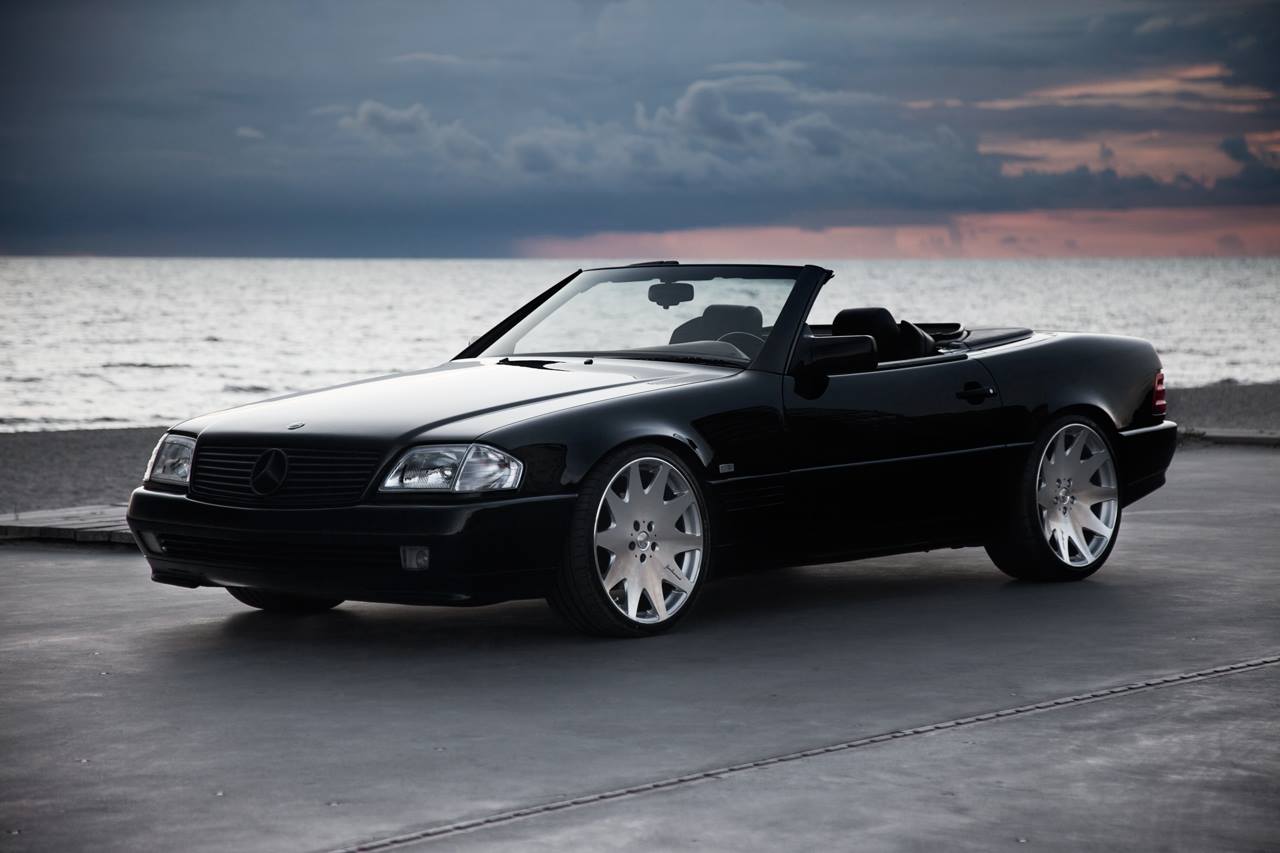

Rolex Air-King: The Brand’s Best Kept Secret?
** Rolex Air-King har alltid ”levt i bakgrunden” för att det är och alltid har varit en billig modell.
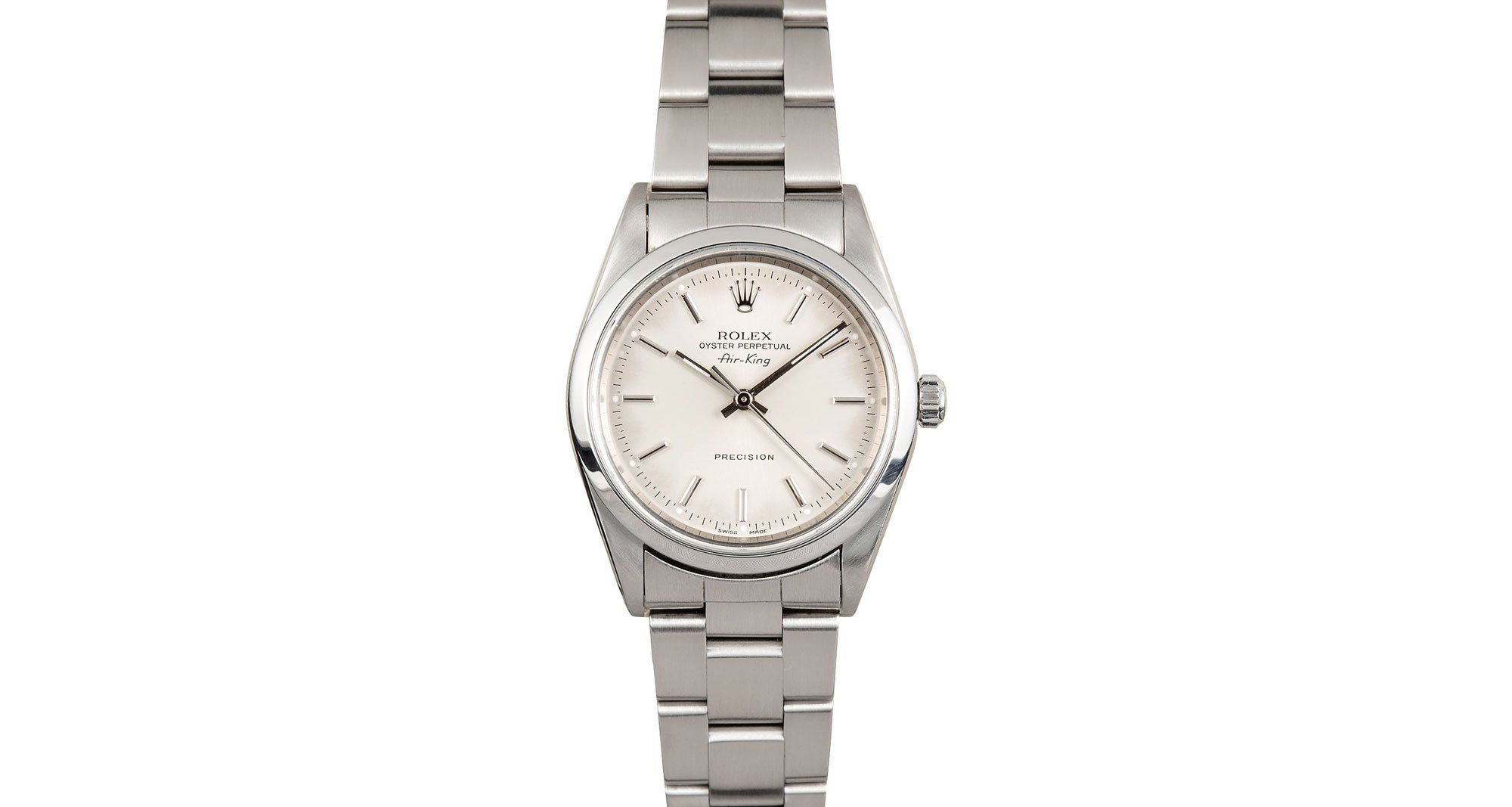
(Ref 1400)
Och har inte varit lika tålig som dykarklockorna och då inte lika häftig, Så av minst dem två anledningarna så har man alltid ”sett ner på” en Rolex Air-King.
Men det har funnits fler anledningar än att klockan var ”billig” och inte tålde att dyka ner till 300 meters djup med.
Det mest seriösa har ju varit att de inte hade lika bra urverk, de hade inte lika snygga visare och markeringar, de var små med bara 34 mm, osv osv osv)
Men jag gillar ändå Air-King, Dagens modell då, främst pga det Gröna (på dagens modell)
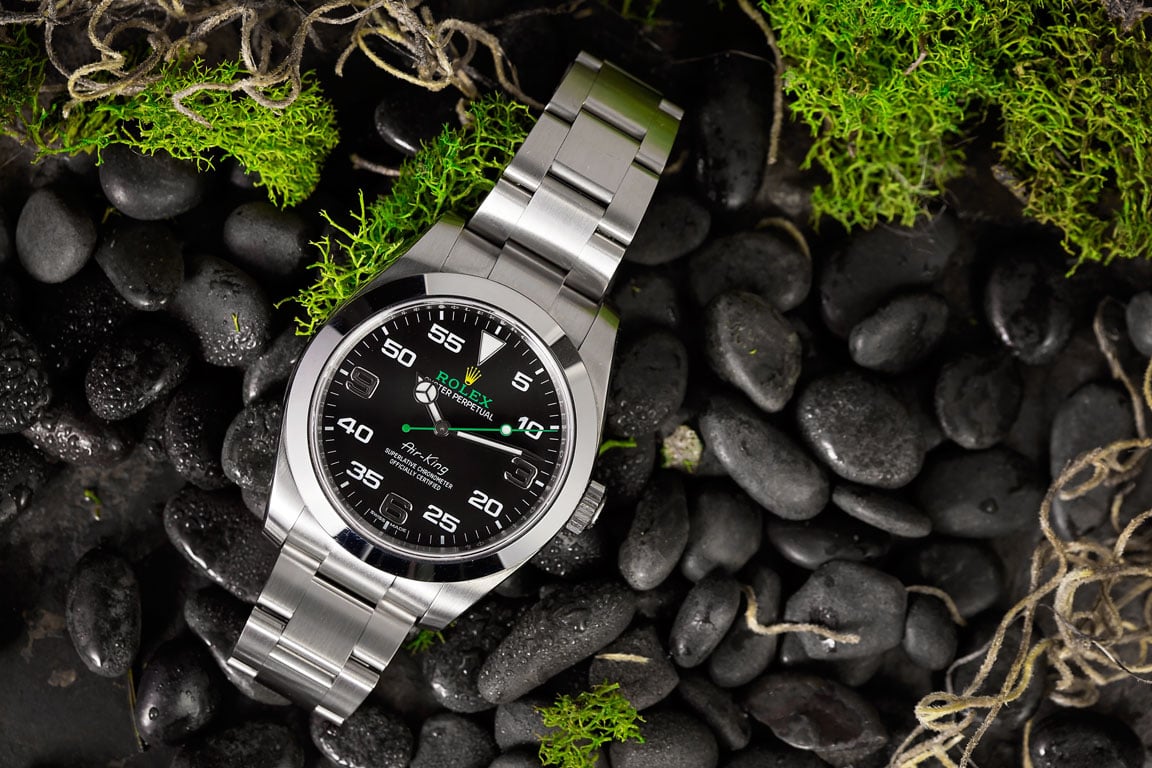
(Ref 116900)
och att 3-6-9 är i stora siffror, som skiljer sig från resten, vilket då under vissa år var det enda (synliga) som skiljde dem från en helt vanlig Oyster Perpetual.
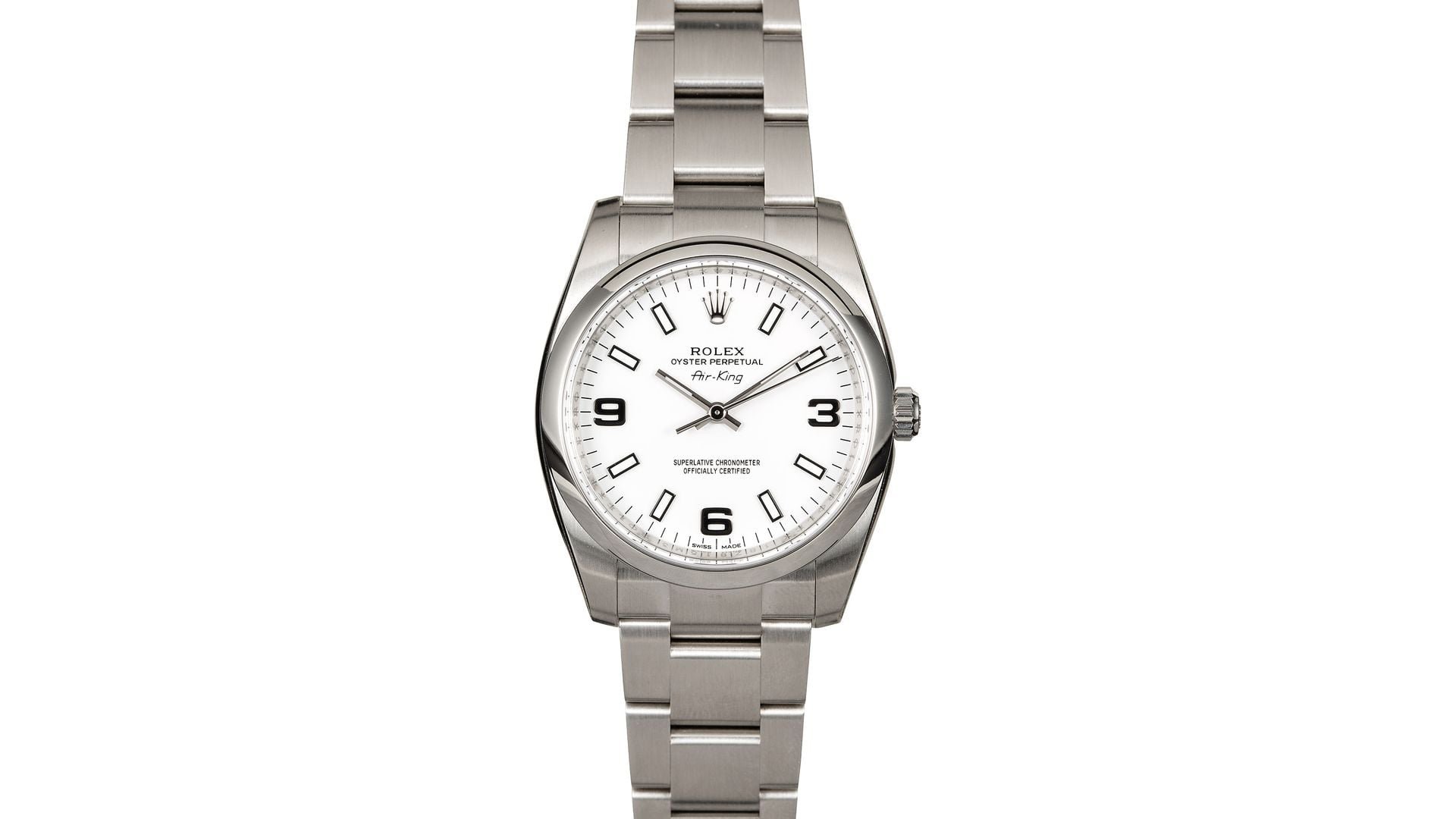
(Ref 114200)

Och en Pilotklocka (som det är även om det inte ser ut som en typisk Pilotklocka) BEHÖVER ju inte vara vattentät alls.
Men ett tag så var Air-King riktigt ful med alldeles för tydliga siffror.

(Ref 114200)
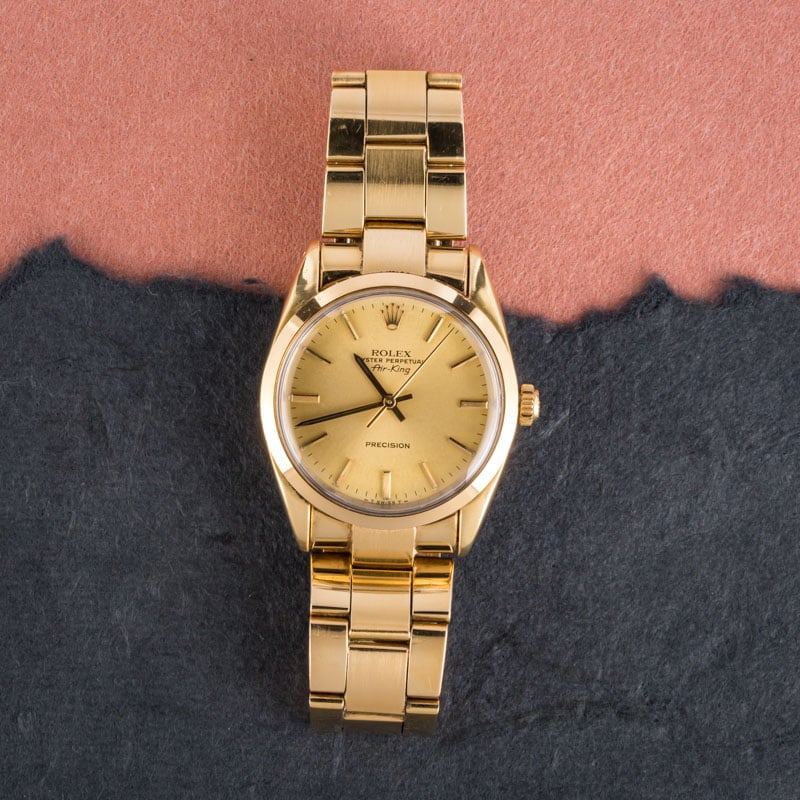
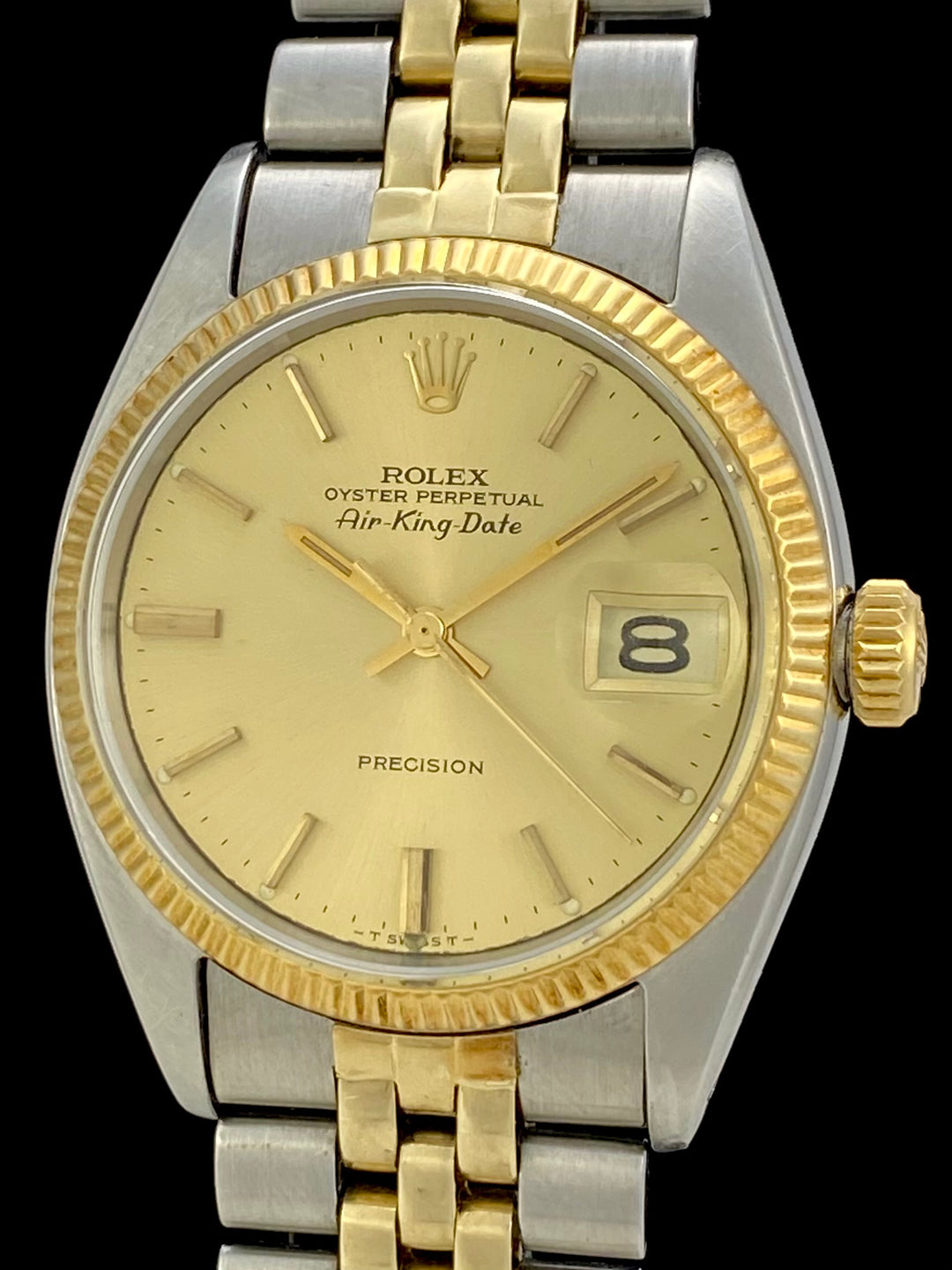
** Men en sak som folk inte alls tänker på idag är att Air-King har funnits i både helguld och Two-Tone,
Och faktiskt även med Jubilee länk.
Men inte ens det har räckt för att de ska vara tilltalande
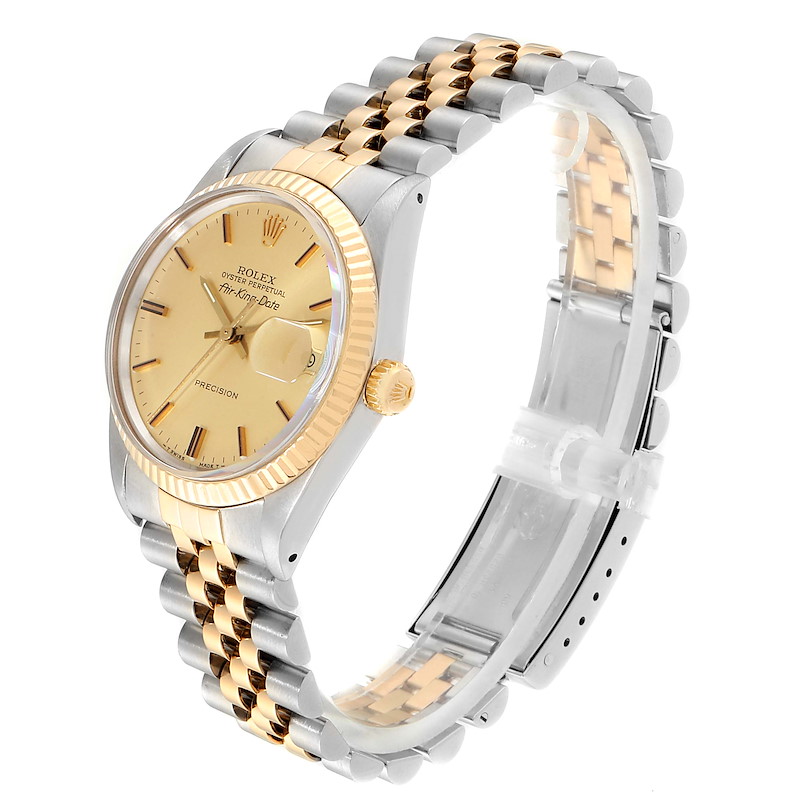
** Rolex Air-King var de första Rolex som jag lärde mig hade lägre guldhalt än 18 Karat.
Jag tänkte ju som liten att självklart så var det 18 Karat guld på alla Rolex, de tillverkas ju på samma fabrik oavsett vart de säljs.
Men ja jag fick sen lära mig att klockor sålda i USA hade lägre karat än 18 Karat.
Och ja 14 Karat ses som det ”fina” i USA.
Men.. Jag har sett Rolex Air-King med 9 Karat guld…

The History of the Rolex Air-King | Bob’s Watches
Rolex Air King’s History – A Sleeping Giant?
Rolex Air King Ref. 126900 Air-King | A Week On The Wrist
Rolex’s Most UNDERRATED Watch: Air-King 126900 Review
Rolex: The Battle Of The Air-Kings – New vs Old
Is The New Rolex Air-King Cooler Than We Think?
2022 Rolex Air-King, Luxurious grab and go or Pilot watch?
NEW Rolex Airking 126900 But Is It Better Than The #116900
https://monochrome-watches.com/history-of-the-rolex-air-king-the-underrated-pilots-watch/
The Evergreens
The History of the Rolex Air-King, The Understated Pilot’s Watch
Far from the popularity of some of the brand’s icons, but still a fascinating and long-lasting collection.
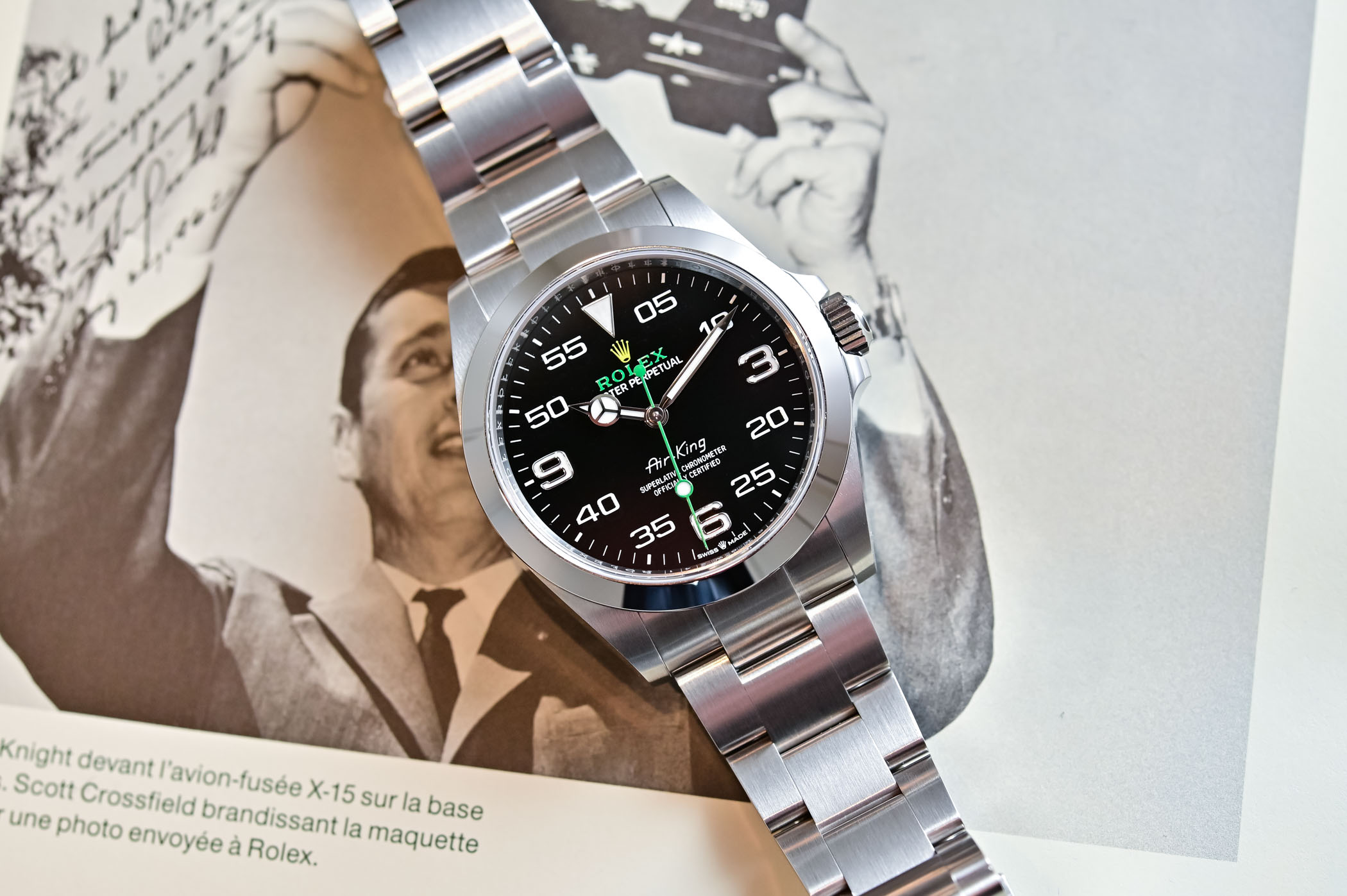
The Air-King is an interesting model within Rolex’s historic portfolio (known as an evergreen if it’s still in production), sometimes dismissed as too entry-level (well, back in the day). The sentiment is somewhat understandable but also misplaced, even if the Air-King sits among the most affordable models on the preowned market today. The watch goes back to the end of World War II with origins that are downright cool, debuting in 1945 to honour British pilots. It’s not a traditional pilot’s watch per se and was more of a tribute, but has evolved into a special series in today’s lineup. It’s also among the oldest of all Rolex models, beating the Explorer, Submariner, GMT-Master, Day-Date and more to the punch. That said, the legendary Datejust also debuted in 1945. Continuing our series of articles about historical Rolex models, we now look at the underappreciated Rolex Air-King.
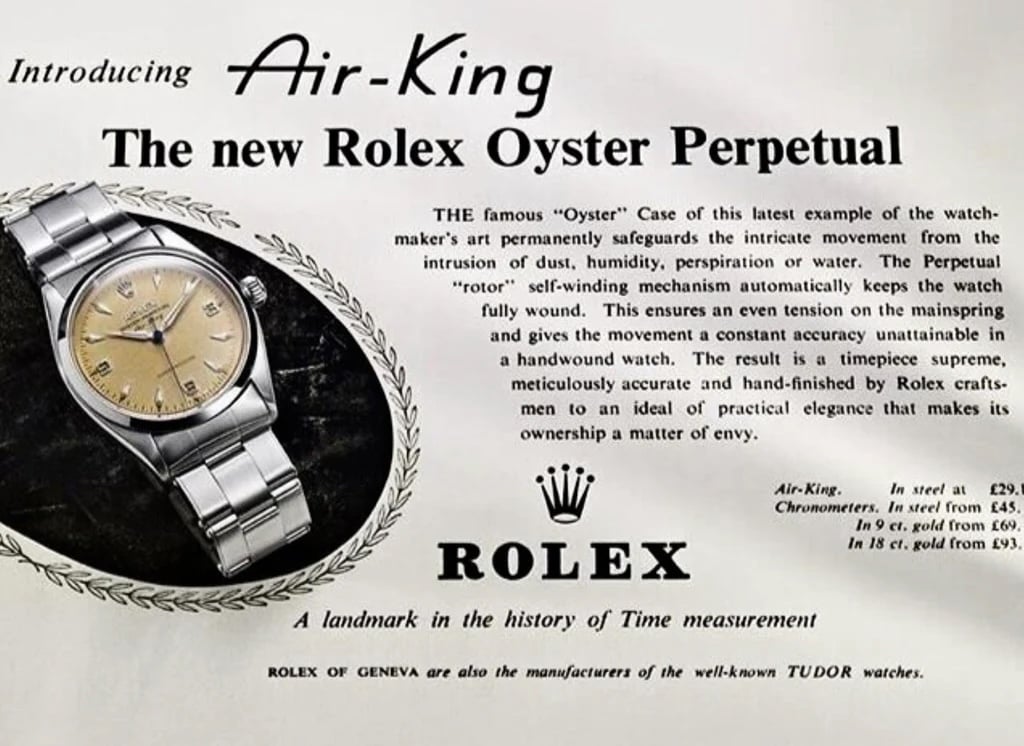
British Royal Air Force
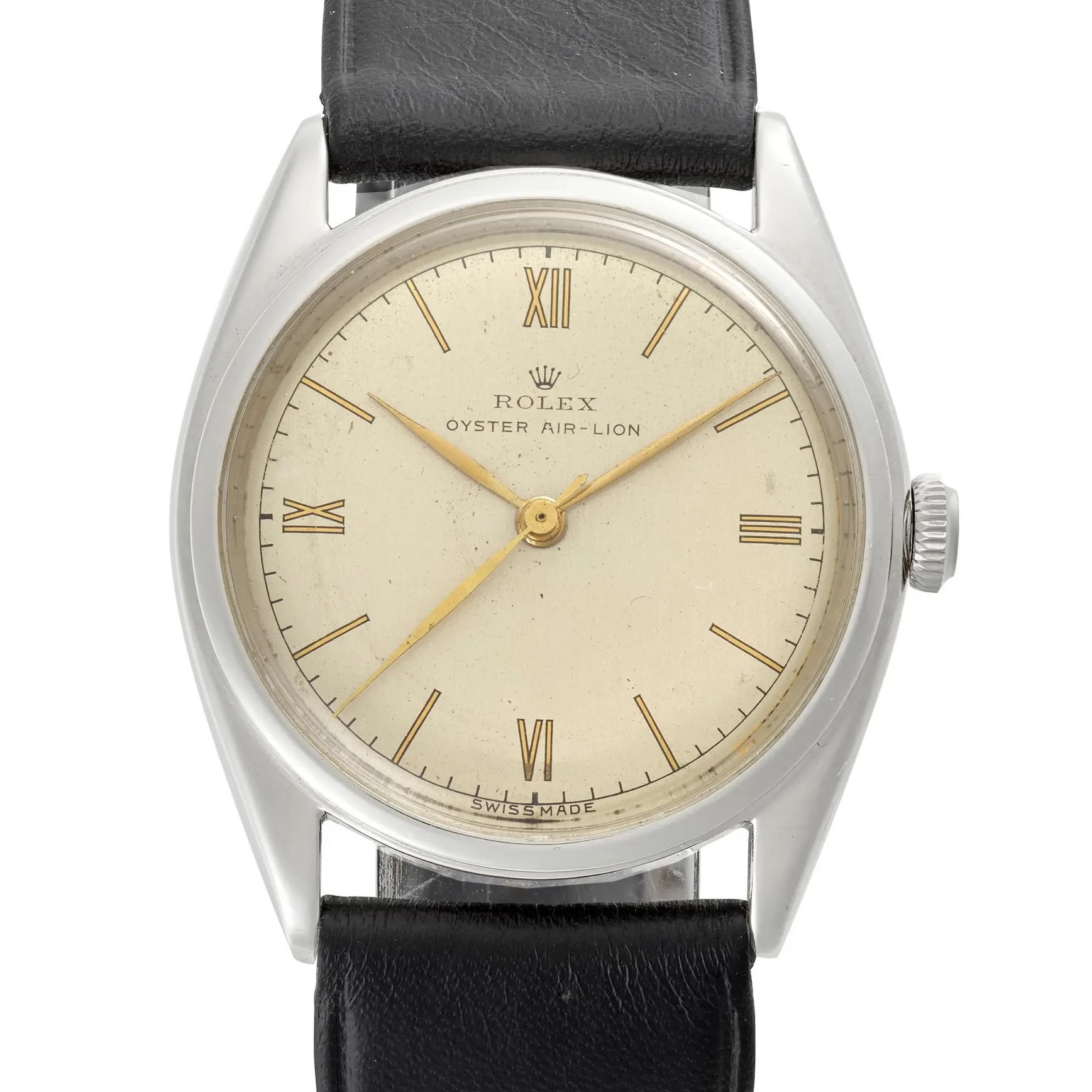
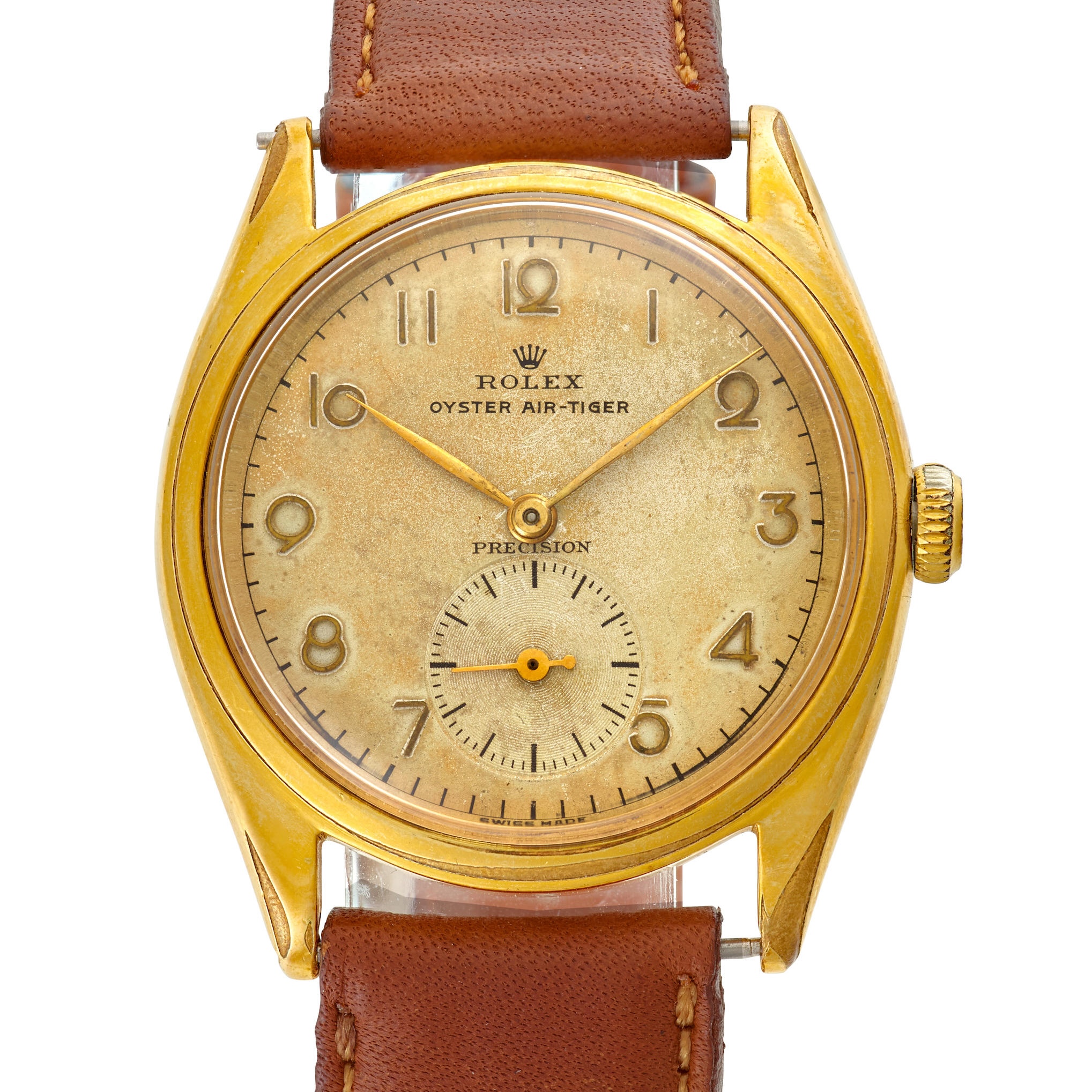
The Air-King was actually part of a broader series of four “Air” models to honour the British Royal Air Force (RAF) with the other three being the Air-Lion, Air-Tiger and Air-Giant. All were similar and the latter three came first (starting in the 1930s) and have long since vanished, leaving the Air-King as the proverbial king of the mountain. Original Air-Kings shared a lot of DNA with early pieces like the Milgauss and Oyster Perpetual, and sometimes they were literally the same watch with some dial variances. Early Air-Kings looked very different from the familiar, simple aesthetic that ran for decades, but like a lot of the crown’s models, experimentation was just par for the course until things were dialled in. Images below by Bonhams.com.
The Air-King Reference 4925, The Hand-Wound Era (1945 – 1953)
This initial Air-King again looked very different from typical models from ref. 5500 (1957 – 1989) and could be mistaken for another model entirely without Air-King being printed on the dial. However, the DNA was there from the start with a 34mm stainless steel (Bubbleback) Oyster case, screw-down crown, respectable (for the time) 50 metres of water resistance and drilled lugs. The dial was an eggshell colour with shallow applied Arabic numerals (gold colour) in an avant-garde font. The Rolex crown was printed under 12 o’clock with ROLEX underneath and OYSTER AIR-KING under that. And that was all there was to it, other than a simple track of matching applied dots spanning the perimeter. Later 4925 models had SWISS MADE printed at the very bottom, but it seems early 1945 dials may have skipped this. Matching (colour) leaf hour and minute hands were used under an acrylic crystal with a blued seconds hand, offering reasonable legibility in a simple, straightforward package. Not quite a pilot’s watch, but again one to honour RAF pilots who flew during the war.
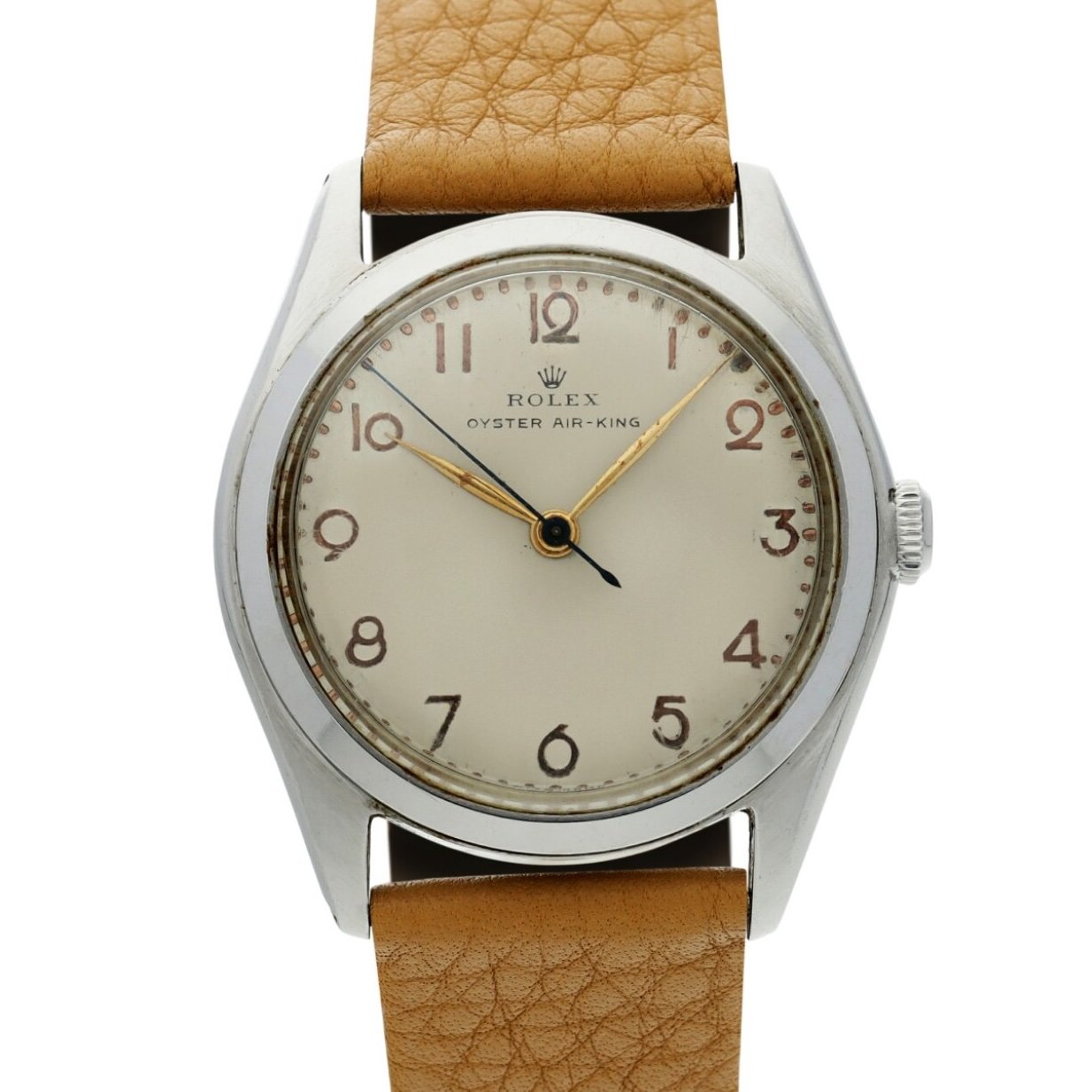
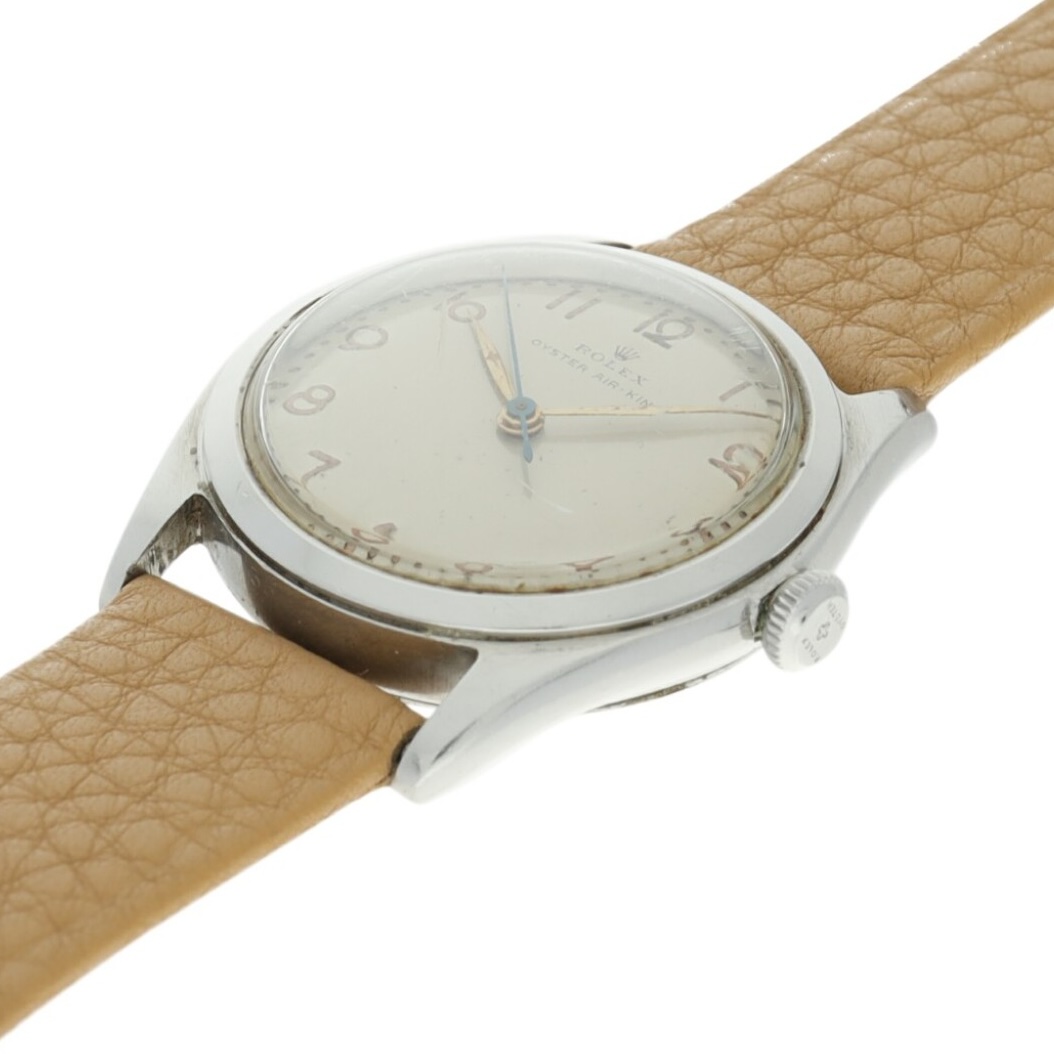
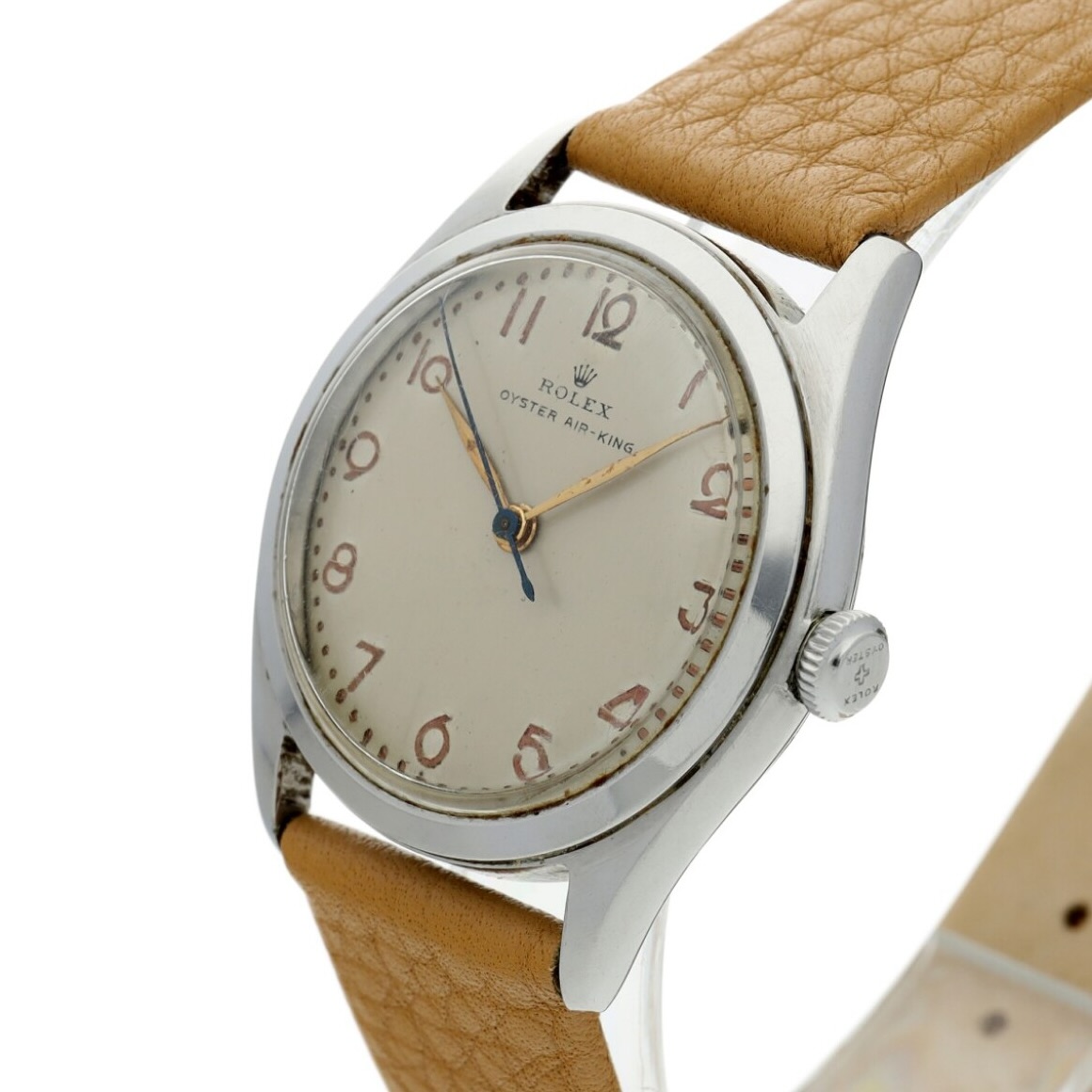
Although the Oyster Perpetual debuted in 1931 with the pairing of the Oyster case and automatic calibre 620 (the Oyster Perpetual name might’ve waited until 1932), the Air-King started life with a more modest hand-wound Hunter movement from Aegler, calibre 10.5. It had 15 jewels and beat at a standard (for the time) 18,000vph or 2.5Hz, and was not a chronometer or even finely adjusted. Despite not having a rotor, the case was a shared Bubbleback design to accommodate automatic counterparts, again why some other Rolex models are identical save for the dial. It was a reliable, perfectly adequate and affordable workhorse, but was upgraded a year later with ref. 4499 that actually ran alongside ref. 4925 until both were discontinued in 1953. It should be noted that Rolex automatics prior to calibre 1030 in 1950 were based on Hunter movements with added modules for the rotor. So, the thicker calibres that resulted again needed the Bubbleback case and Rolex wasn’t going to design a new one just for the Air-King.
The Air-King Reference 4365 (1945 – 1953)
This reference and ref. 4925 basically ran together from start to finish, but the differences between the two were surprisingly stark. For starters, ref. 4365 had a large small seconds sub-dial in lieu of central hands, so they used different hand-wound movements (although both based on calibre 10.5). The reasoning is that it was also made as Air-Lion and Air-Giant models, so the differentiation makes sense. It shares dial features with both ref. 4925 and the upcoming ref. 4499, starting with the flat applied indices of ref. 4925 but a more contemporary printed outer track that’s continued on ref. 4499. PRECISION is now printed on the dial like ref. 4499, but tightly wedged between the top of the sub-dial and central hands. It indicates a slightly improved variant of calibre 10.5 that most likely went to 17 jewels from 15 (also seen with ref. 4499 with its updated calibre 10.5, but with a central seconds hand). The leaf hands were also narrower than ref. 4925, just like ref. 4499, along with the addition of SWISS MADE at the bottom of all dials.
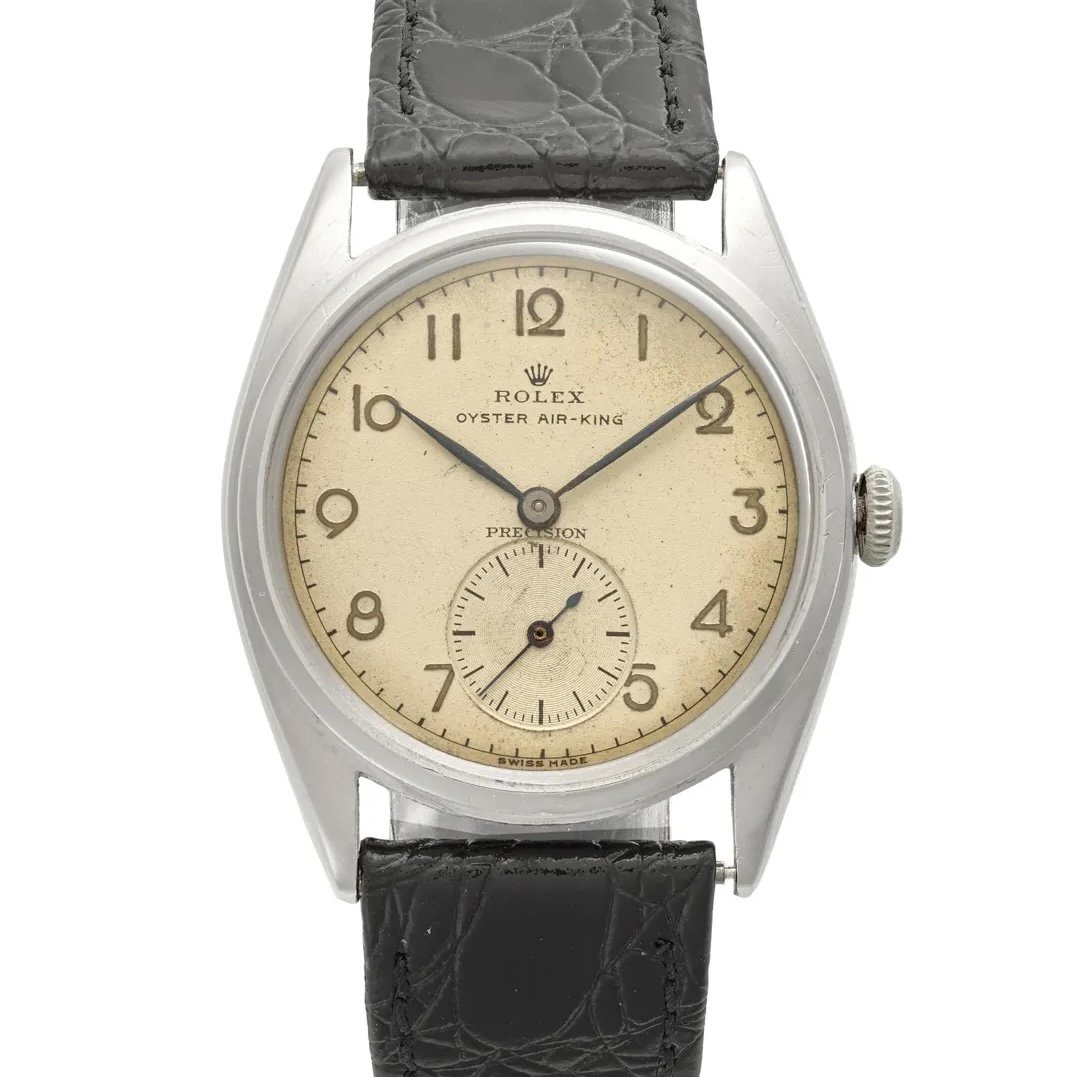
The Air-King Reference 4499 (1946-1953)
This is arguably the next actual Air-King after ref. 4925 as ref. 4365 was shared across multiple Air models. It wasn’t a big change from the original piece, but there are several notable differences. The applied indices had the same font, but were narrower, taller and black instead of gold. The more detailed and conventional printed minute/seconds track from ref. 4365 returned along with PRECISION, now printed comfortably above 6 o’clock without obstacles. SWISS MADE again appeared at the bottom of the dial, which would be a permanent fixture moving forward. The same (or very similar) leaf hands from ref. 4365 are also here in black and combined with the darker, more pronounced indices, legibility significantly improved. This reference represented a maturity of the Air-King with better dial elements and an updated calibre 10.5 with 17 jewels and all central hands.
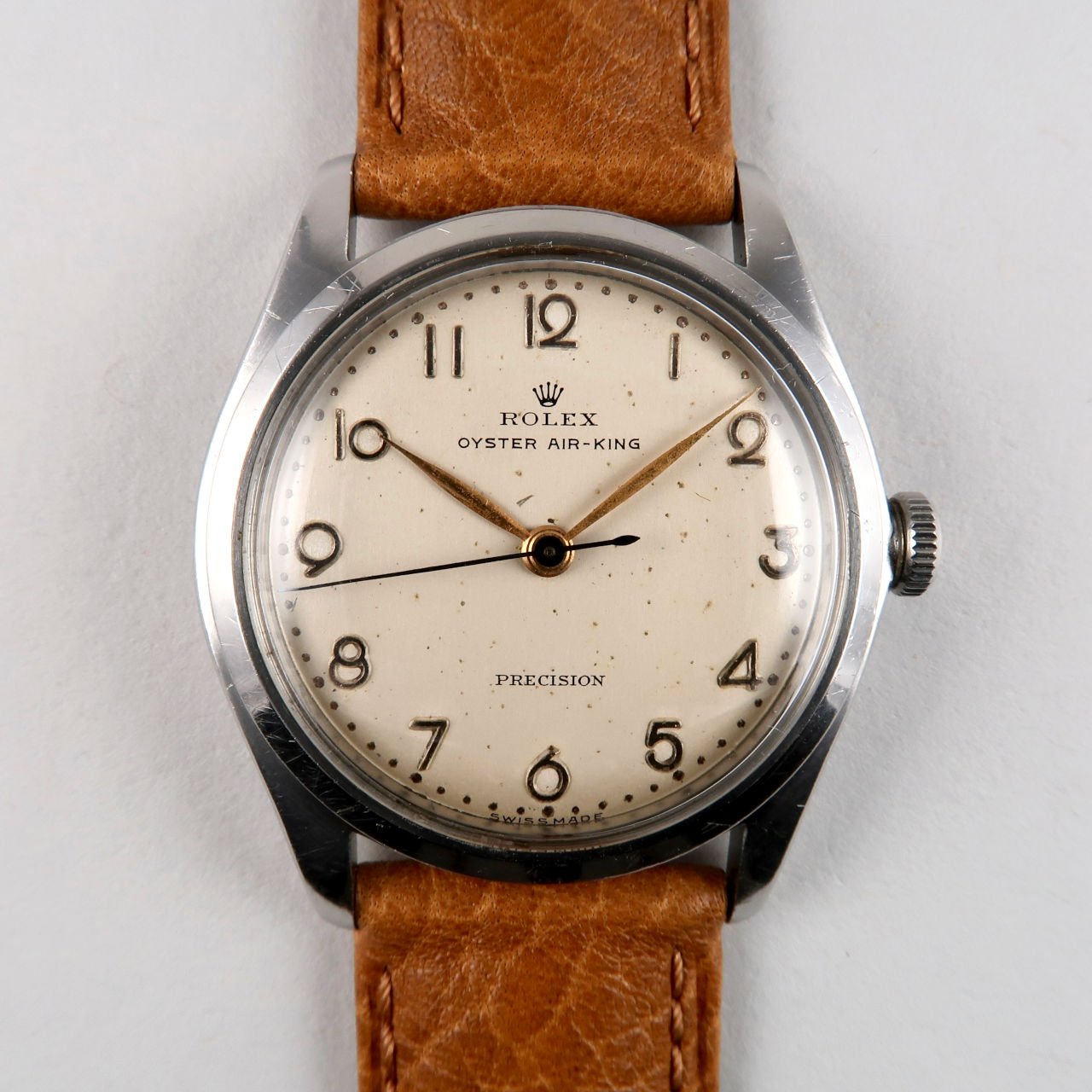
Remember when I said that Air-Kings were sometimes identical to other Rolex models save for dial print? Well, some models early on actually shared the reference number 4499 as well. It’s a bit hard to believe today, but in the early and mid-20th century, Rolex was disorganized when it came to cataloguing specific models, variances within references, exact calibre numbers and so on. It’s today’s collectors that tend to clarify details and fill in the gaps.
The Air-King Reference 6552 (1953 – 1957)
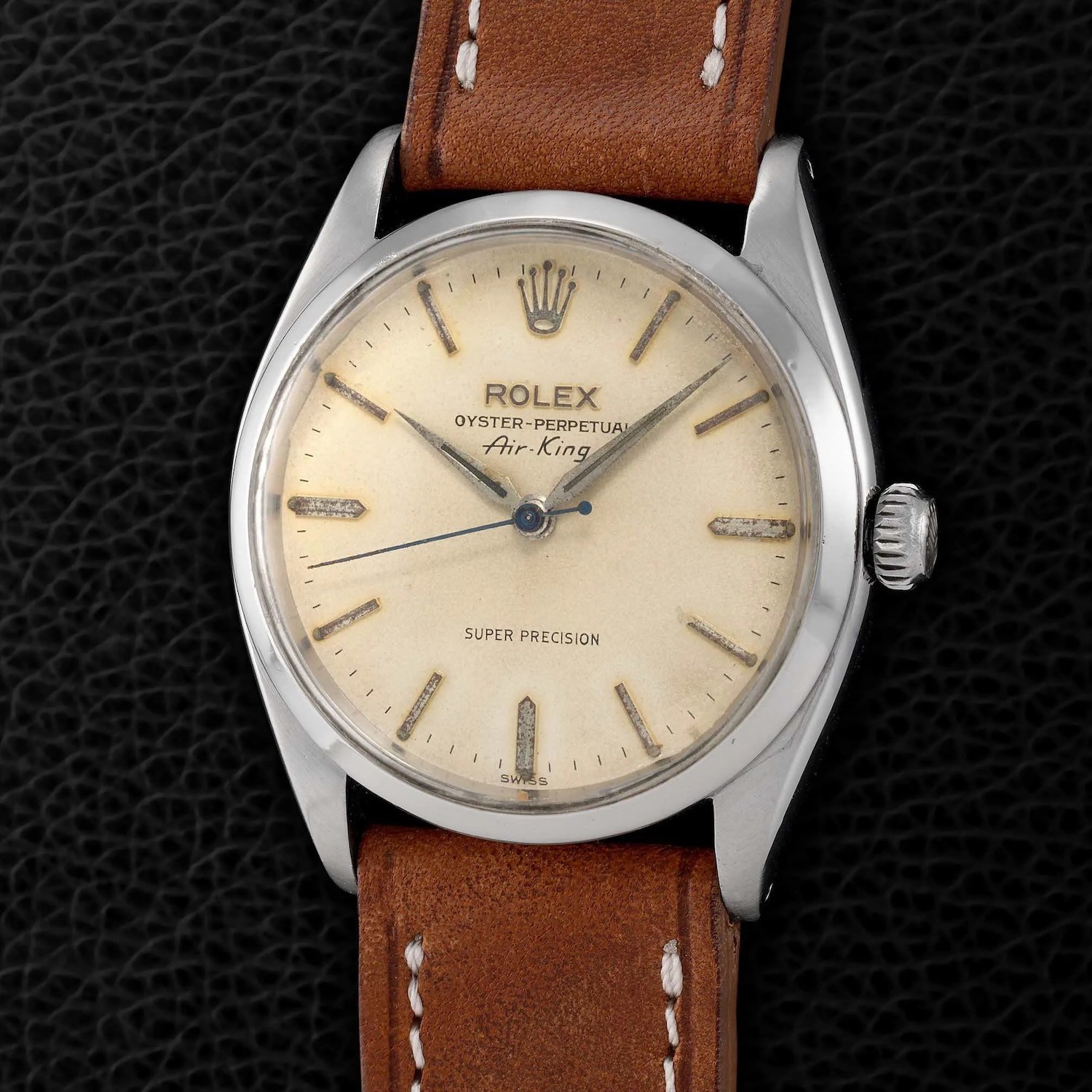
This was the first real leap for the Air-King with significant changes to the dial and movement. The dial layout doesn’t exactly represent what the Air-King would become, having polished and faceted “spear” indices and Explorer(ish) Arabic numerals at 3, 6 and 9 o’clock (although the latter does make a triumphant return). However, later 6552 dials would get the more classic stick indices that represented the future of the model. This is what it looks like when Rolex throws everything at the wall early on to see what sticks. Alpha hour and minute hands replaced their leaf counterparts and had radium lume inserts for the first time. PRECISION was replaced by SUPER PRECISION to indicate the new and improved automatic movement. The Rolex crown and ROLEX itself were now applied and Air-King was printed in the classic script for the first time (and not in all caps). What hadn’t changed were the 34mm case, acrylic crystal, drilled lugs and water resistance. The outer minute/seconds track also gained additional marks with a pattern of long and short for better timing. And finally, this was the first Air-King to start using the 3-link Oyster bracelet from the factory.
Calibre 1030 and the Dawn of In-House Production
The biggest change was under the hood with calibre 1030, transforming the Air-King into an Oyster Perpetual model. It still had a 2.5Hz beat rate, but also 25 jewels, better accuracy and it never toyed with the small seconds layout. This was the brand’s first fully realized in-house movement (launched in 1950) with a “butterfly” bi-directional rotor for better efficiency and an optional chronometer rating, and was also used in early Explorers and (no-date) Submariners. Prior Rolex automatics again used base Hunter movements with an added module for the rotor. Ref. 6552 was clearly not taking a back seat to other models with its new in-house Oyster Perpetual powers, establishing itself as a simple yet high-end watch that leaned to the dressy side without pretending to have sporty intentions.
The Air-King Reference 6652… Well Dude, We Just Don’t Know
This is supposedly a transitional Air-King with calibre 1030 leading up to ref. 5500, but there’s not a lot to go on. Many connoisseurs insist that it never actually existed, while others maintain it’s the product of Rolex’s early sloppiness with cataloging. Whether or not ref. 6652 is a bona fide Air-King or another model entirely isn’t exactly clear, but it’s often been intertwined with ref. 6552 and might even be the same model with the “wrong” reference number. That’s if it really exists at all. Just a little more Rolex lore (and forgive the Big Lebowski reference).
The Air-King Reference 5500, The Modern Air-King is Born (1957 – 1989)
This is the longest-running Air-King reference and represents the aesthetic that most Rolex collectors and enthusiasts think of. There were tweaks and updates during its 32-year run, but the general formula was now clearly established. The first modern Air-King was born, but it would continue to evolve into the 21st century with major changes. It remained smaller than the norm at 34mm in diameter when models like the Explorer and Datejust were 36mm. And talking about the Explorer, from 1958 to around 1967, there was a 5500 Explorer in this 34mm case (Explorers were otherwise 36mm). A typical Rolex experiment that resulted in an Air-King/Explorer hybrid that tried to leverage the best of both models in an affordable package – these were not certified chronometers like the certified Explorers 6610 or 1016 at the time. Like the Air-King, they had PRECISION on the dial instead of SUPERLATIVE CHRONOMETER OFFICIALLY CERTIFIED. Collectors dig them today and they’re among the hardest to find. However, many consider them Explorers instead of Air-Kings altogether and I tend to agree.
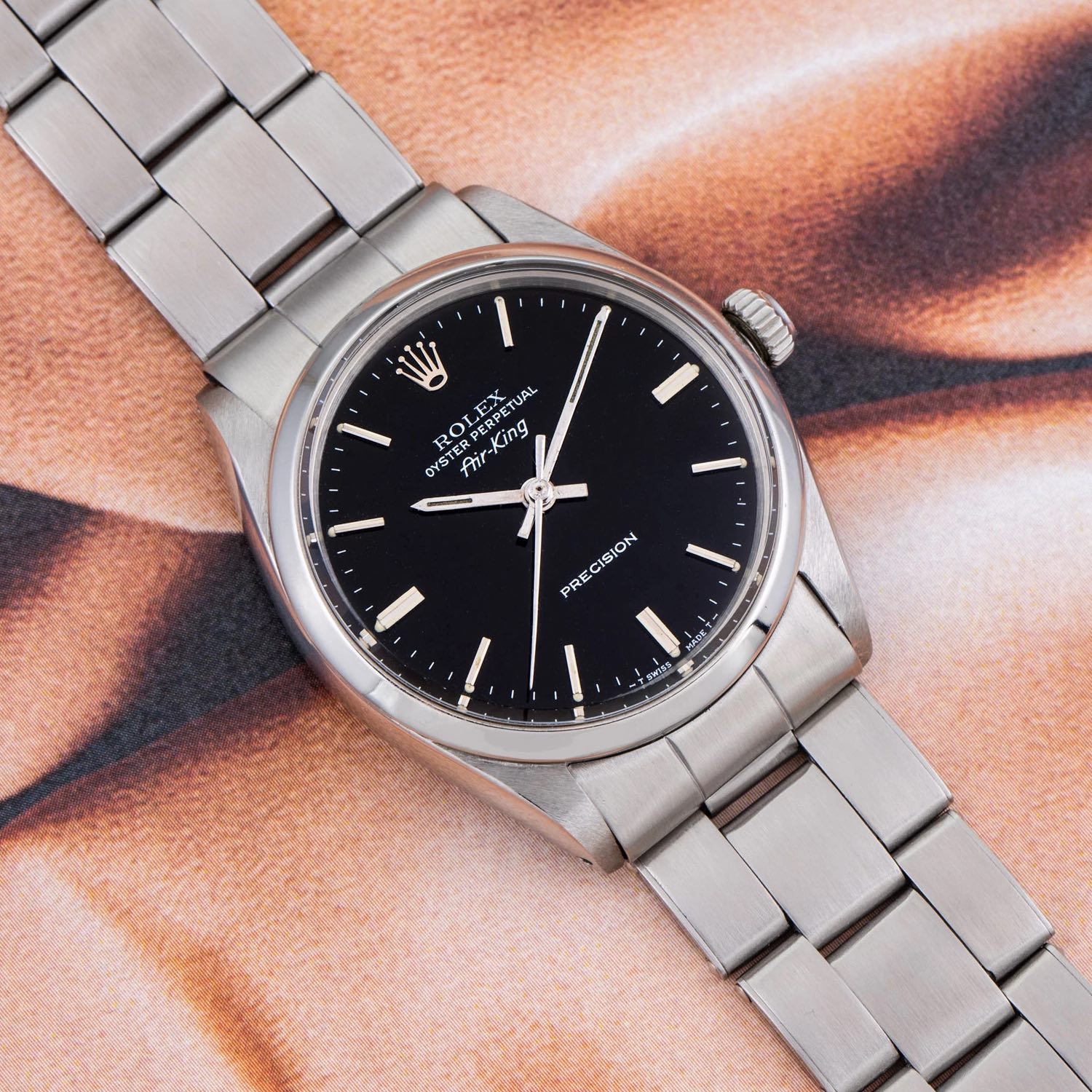
As a long running reference, variances are all over the map, starting with “Pre-Precision” models. Depending on the market, ref. 5500 models had either calibre 1520 or 1530 with the latter often having SUPER PRECISION on the dial over the 1520’s PRECISION. This was inconsistent, however, and some models had PRECISION or SUPER PRECISION regardless of movement, while a handful of early models had nothing at all, hence the “Pre-Precision” moniker. These are very rare today and prized by collectors. In addition to the scattershot nature of the day, service and repairs (and potential minor upgrades) resulted in inconsistencies with dial designations, movements and so on as well. Then there are rarities like the “double red” dials with Air-King and SUPER PRECISION printed in red.
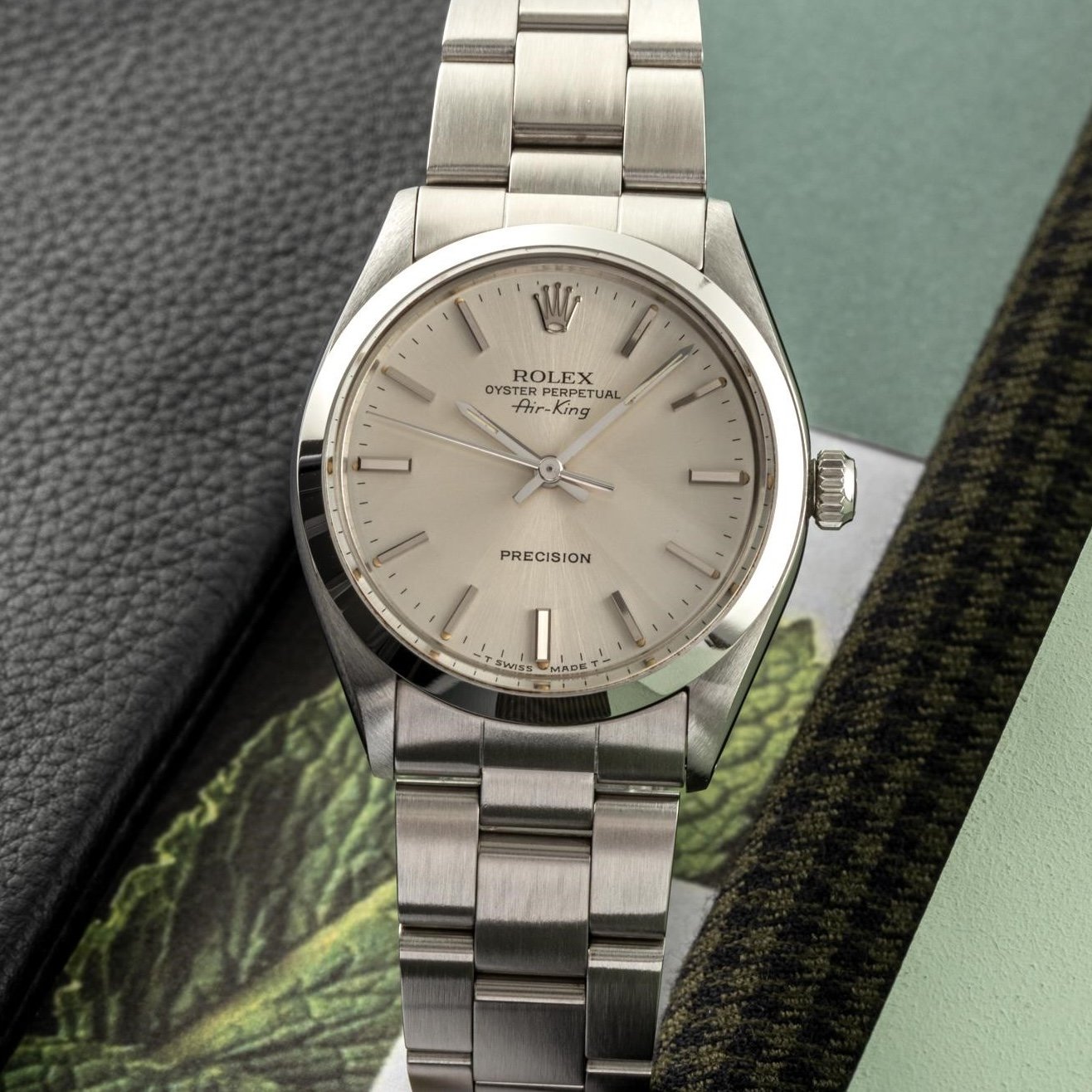
Overall, the general formula was here and the 5500 Air-King was a simple and affordable piece that offered the full Rolex experience without bells and whistles. The smaller 34mm case, lack of complications and absence of a chronometer certification kept the price down compared to the (proper) Explorer and Datejust, but the in-house automatics, standard Oyster bracelet, Oyster case with screw-down crown and overall fit and finish made it a favourite for many. And let’s talk about style. The dial elements were (mostly) cosnsitent at this point with a majority having silver or light dials, baton hands and stick indices (a Rolex aesthetic certainly not limited to the Air-King). As the years progressed, black and slate grey dials became popular as well. Water resistance was now 100 metres.
Corporate Dials
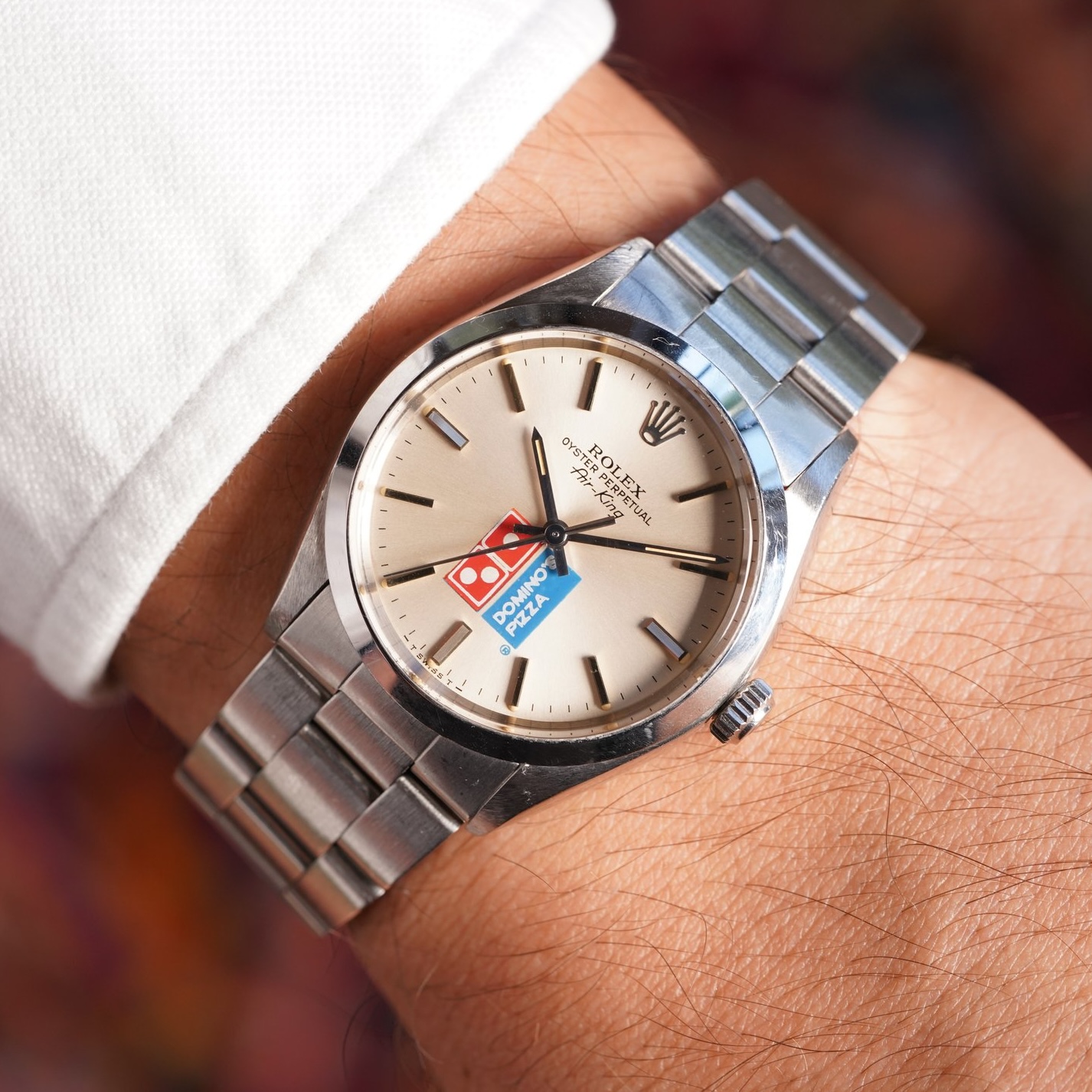
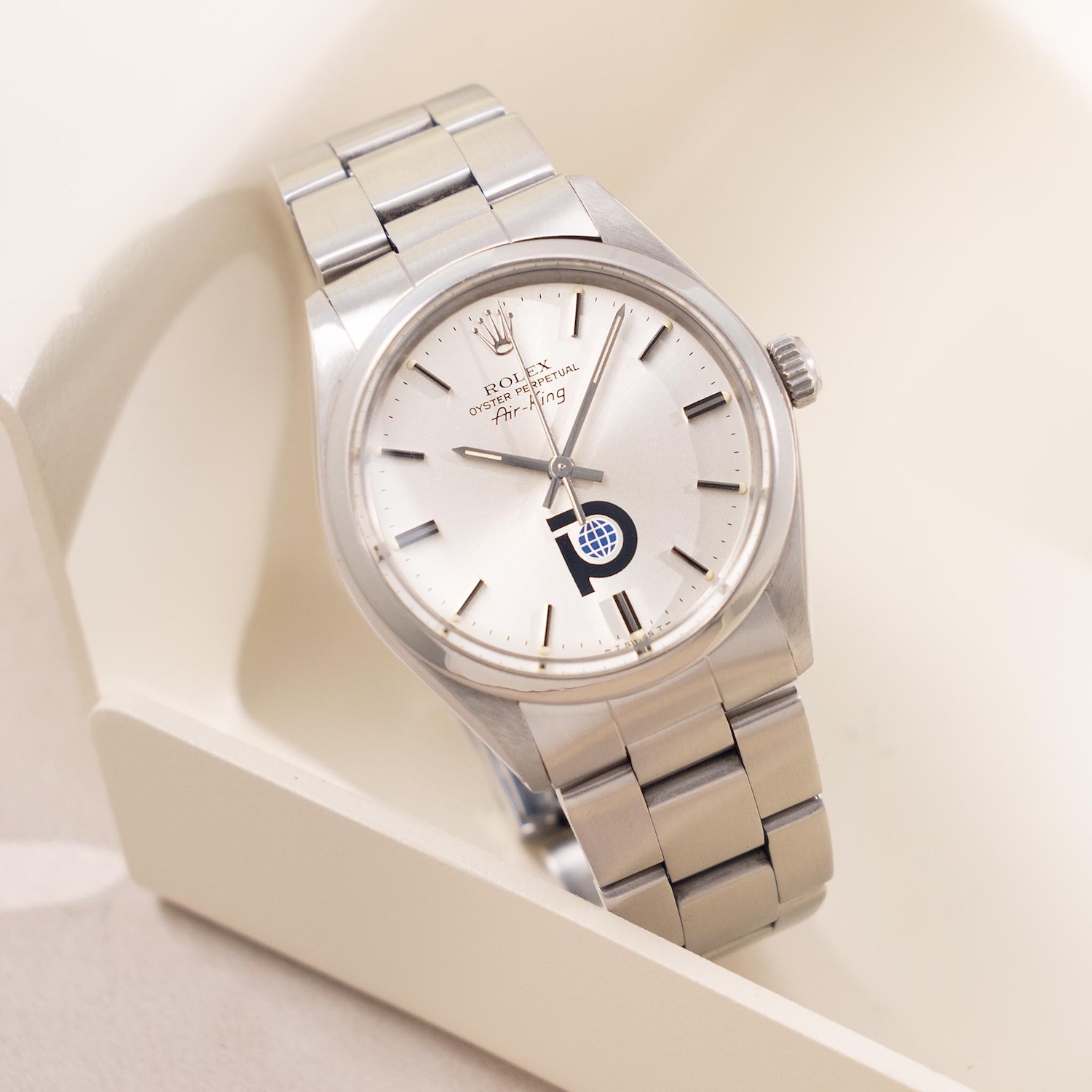
Rolex has a long history of corporate dials, (probably) starting with a “Yankees 1956 World Champions” dial on Yogi Berra’s gold Oyster Perpetual. Rolex actively advertised for logo dial placements and Ref. 5500 became a favourite of businesses looking to provide a Rolex as a luxury bonus, retirement gift and so on. Popular examples today include dials printed with a Domino’s Pizza or Levi’s logo above 6 o’clock, but countless examples are out there from foreign government crests to obscure sporting events. Of course, this wasn’t limited to the Air-King as logo dials were made for the Oyster Perpetual, Datejust, Date and many more, but the Air-King’s classic style and more affordable price seemingly made them best suited for the roll. There was even a very rare Submariner with a Panama Canal dial from 1999. As a quick note, all Mickey Mouse Rolex dials are aftermarket additions as Rolex never sold one from the factory, so buyer beware. Corporate dials are hit or miss with collectors today, but many are still worth more than their conventional counterparts, such as the aforementioned Domino’s 5500.
Below, two examples of corporate dial Air-King 5500 – a classic Domino’s Pizza (image by windvintage.com) and another example with Pool Intairdril Dial (image by bulangandsons.eu)
Calibre 1520 and 1530
In 1957, Rolex introduced calibre 1530 (before 1520) as a “super precision” in-house automatic for the Air-King that didn’t require a chronometer rating. Early pre-chronometer Submariners got this calibre as well, while a relative handful of 1530s got a chronometer rating for specific models. Over the years, it evolved a bit as the butterfly rotor was replaced by a more conventional “half-moon” type, Teflon-coated red gears replaced brass (with the aesthetic we still see today) and the jewel count increased from 25 to 26 for some. All beat at 18,800vph (2.5Hz) and had a 44-hour power reserve. Calibre 1535 was a variant with a date complication (see ref. 5700 below). There were also 17-jewel versions of 1530 and 1520 to avoid tariffs in certain markets, generally the United States.
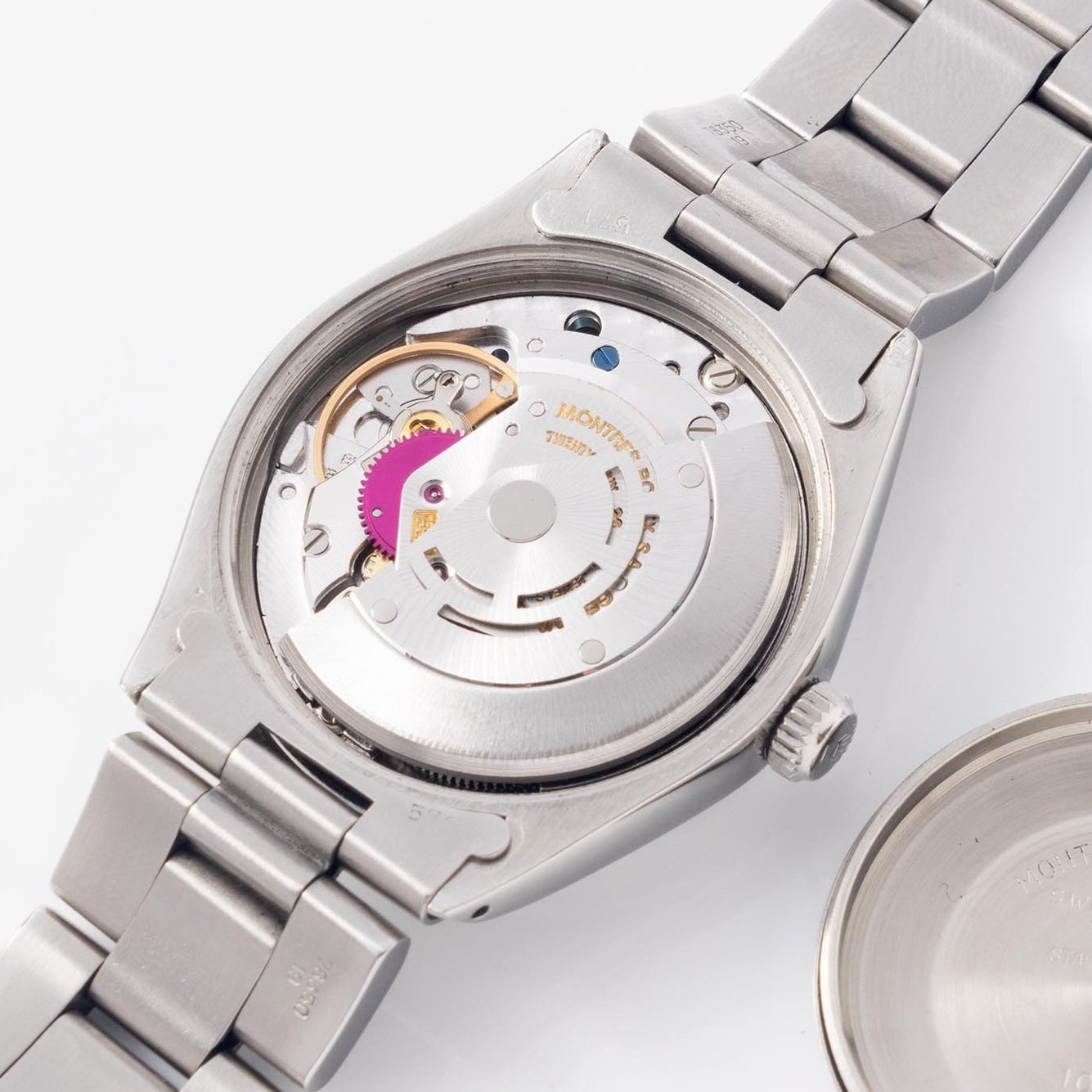
Calibre 1520 was a modest upgrade and also a cost cutting downgrade to 1530 with a slightly higher beat rate of 19,800vph (2.75Hz) and 26 jewels for all movements (save for a possible lower jewel count to avoid tariffs). The power reserve was listed as 42 hours, so a slight downgrade from calibre 1530 and it didn’t use a Microstella regulator like calibre 1530, hence the PRECISION designation even with a higher beat rate. This movement was used in early Submariners as well.
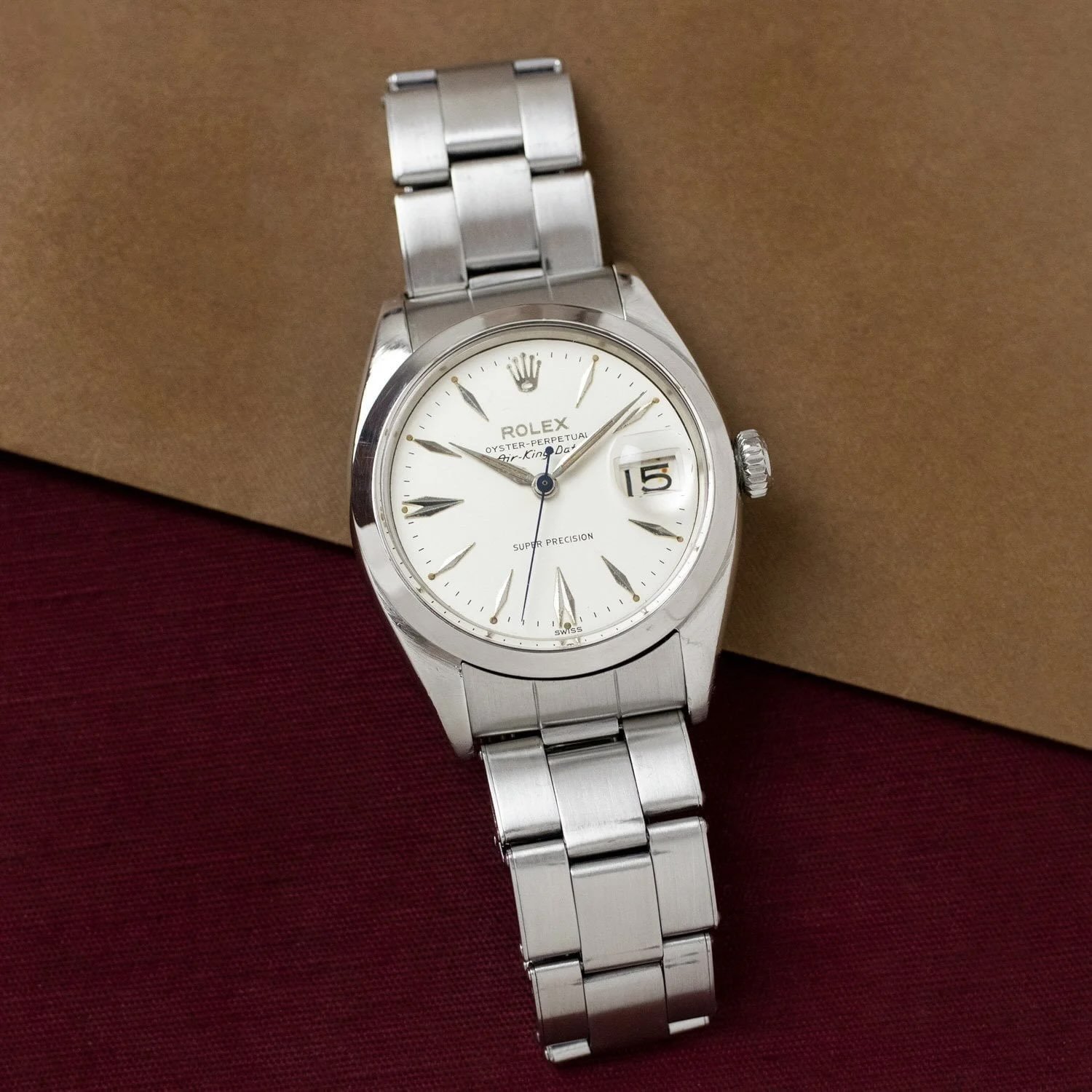
The Air-King Reference 5700, Air-King Date (1959 – 1988)
A cool variant of ref. 5500 is the Air-King Date, ref. 5700, which (as the name implies) simply adds a date window at 3 o’clock under a Cyclops lens and acrylic crystal. These were otherwise the same as the standard 5500 models and similar to the Oyster Perpetual Date models of the time, minus the official chronometer designation. Ref. 5700 had the familiar smooth bezel, while a rarer two-tone (Rolesor) model appeared later with a fluted bezel and gold dial elements (ref. 5701). With the added date complication came an upgraded movement, calibre 1535, although some used calibre 1525 and both were PRECISION movements and not chronometers. Dial colour options were generally silver, black, white and champagne. Curiously, there was also an Air-King Date ref. 6500 with a black dial introduced in 1975.
A Few Anomalies
While ref. 5500 was a relatively unchanged and stable run for over 30 years, some weird anomalies were not uncommon for Rolex reference series at the time. In 1960, ref. 5506 (and three other references) debuted with 14-micron gold capping, which is rolled onto the steel unlike traditional gold plating (although the aesthetic was nigh identical). A matching Oyster bracelet came fitted. Then ref. 5501 brought a two-tone Rolesor model with a gold fluted bezel and crown, fitted with a two-tone Oyster bracelet and later a comparable Jubilee. Ref. 5502 had a gold case with a smooth bezel, black dial and Air-King in large script above 6 o’clock. Ref. 5504 had a set of Alpha hands and larger applied indices at 3, 6 and 9 o’clock, all packaged in a larger 36mm Explorer 1 case with calibre 1530. This was not, however, like the earlier 5500 Explorer hybrid.
Other changes include the switch to tritium in the mid-1960s from radioactive radium (recognized with T SWISS T at the bottom) and the introduction of a quickset date for 5700 models in the 1970s.
The Air-King Reference 14000, Contemporary Features in a Familiar Package (1989 – 1999)
From an enthusiast’s standpoint, this is probably the Air-King to get. It maintains much of the character from ref. 5500, but adds a contemporary sapphire crystal and new movement, calibre 3000 (not yet a chronometer). Increasingly uncommon pencil and Alpha hands were now completely gone, replaced with the latest baton hands as seen on the Datejust and others. The drilled lugs were gone as well. Salmon and blue dials joined the pack and dial designs really expanded with different indices, Roman numerals, Arabic numerals at 3, 6 and 9 o’clock (as seen with previous references) and so on. Of course, the familiar and simple Air-King dial layout from before still dominated the series. In 1998, the switch from tritium to LumiNova was complete and T SWISS T changed to SWISS at the bottom of the dial, and Super-LumiNova came to dials soon after that.
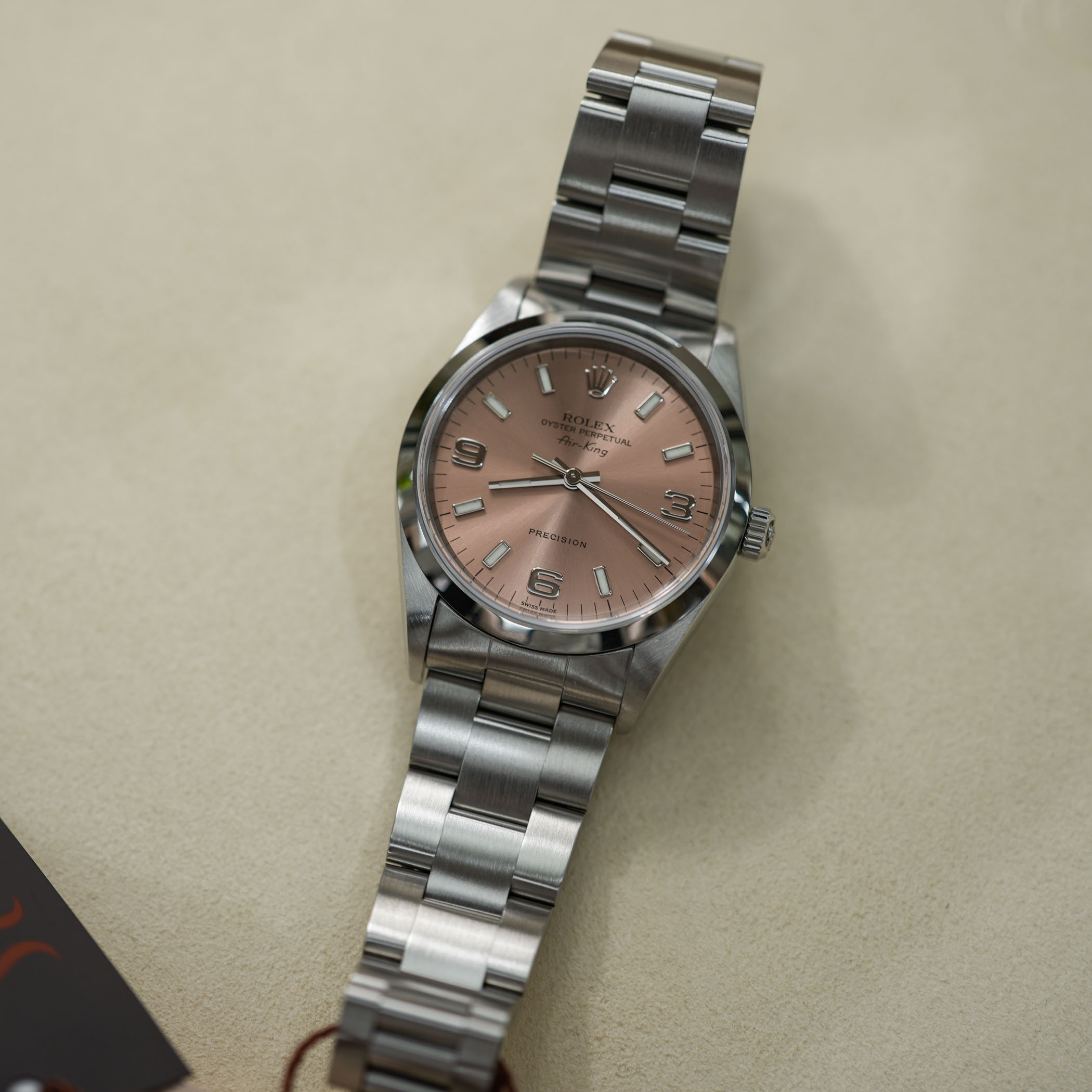
Calibre 3000 was a solid upgrade with 27 jewels, a beat rate of 28,800vph (4Hz) to match the brand’s broader portfolio and a 42-hour power reserve. It was used for some no-date Submariners and Explorers for a time as well. It had a flat hairspring without overcoil and a simplified adjustable mass balance, and was a reliable in-house workhorse until ref. 14000M replaced it in 2000.
The Air-King Reference 14000M (2000 – 2006)
This reference (“M” for a modified ref. 14000) upgraded the movement again, this time with a certified chronometer – calibre 3130. Spec bumps included 31 jewels from 27 and a new Parachrom hairspring. Although 3130 was the first COSC-certified Air-King movement, PRECISION remained printed on the dials. Little else changed overall and both 14000 and 14000M shared dial variances, although as mentioned, Super-LumiNova replaced LumiNova.
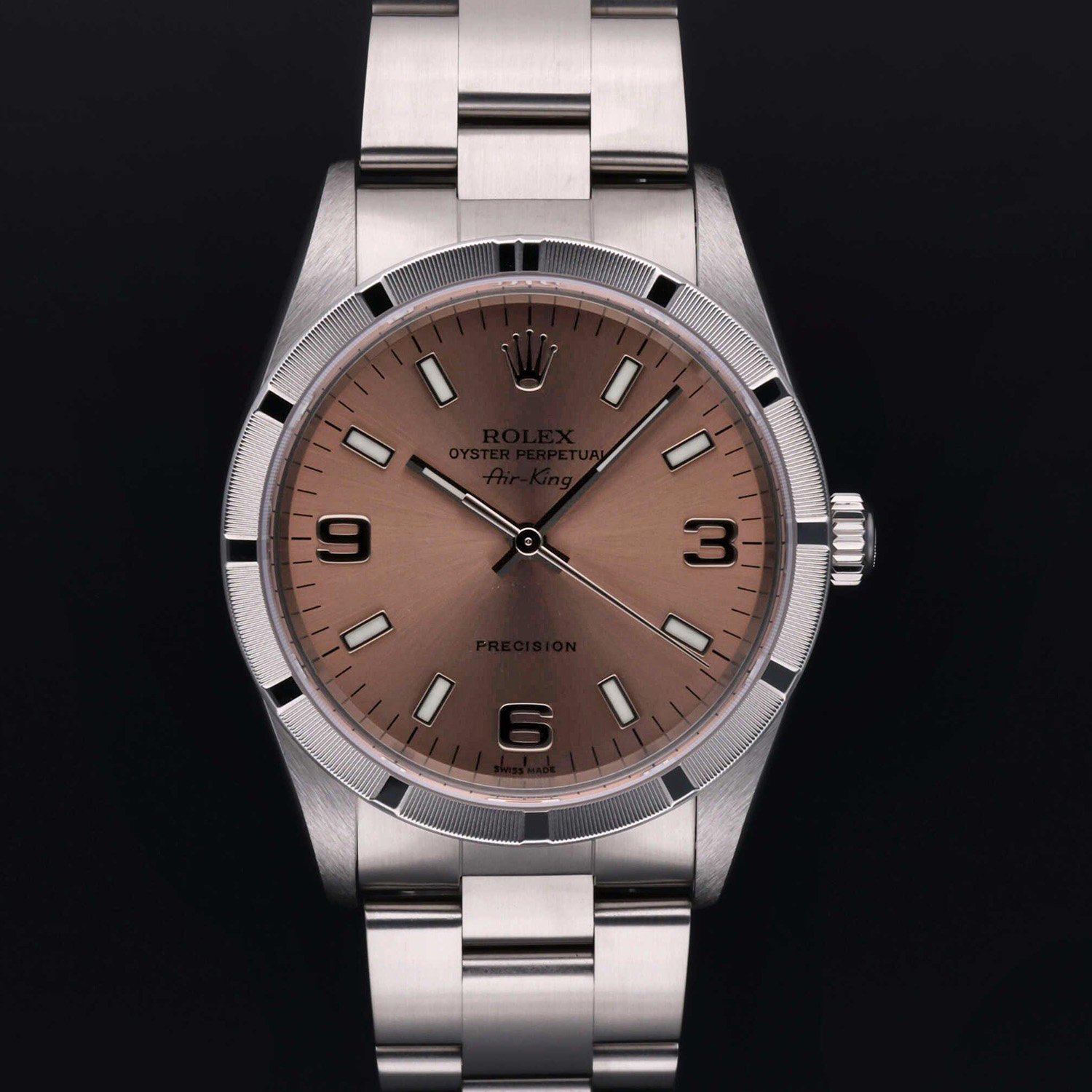
The Air-King Reference 14010/14010M with Engine Turned Steel Bezels
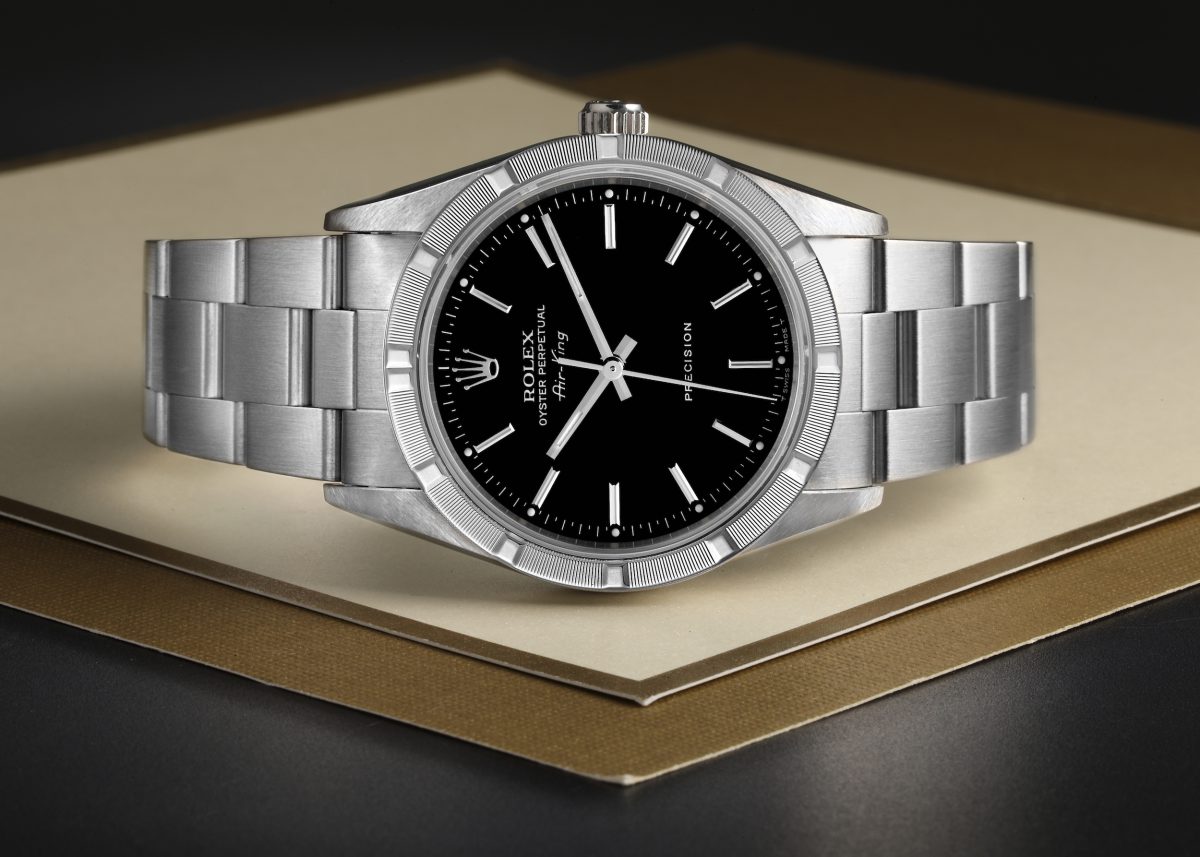
Ref. 14010 (1991 – 2001) and ref. 14010M (2000 – 2006) had special engine-turned bezels with fine grooves between polished plates that were adjacent to the main dial indices (double plate at 12 o’clock). This was simply a machined bezel for aesthetics and the models were otherwise identical to ref. 14000 and 14000M.
The Air-King Reference 114200, The Air-King Matures (2007 – 2014)
Although we saw a lot of dial variances emerge with the ref. 14000 series, things really went crazy with ref. 114200, the first six-digit Air-King reference (along with 114234) before there was a multi-year production gap. Let’s start small and we’ll go from there. For starters, all dials now had Rolex’s own Chromalight, replacing Super-LumiNova. SWISS MADE was once again standard at the bottom of the dials as well, but dials were now all over the map with colours including black, white, green, blue, salmon and champagne with some having Roman numerals, applied Arabic numerals, exotic dials, two-tone variants and so on. The familiar Explorer setup with applied Arabic numerals at 3, 6 and 9 o’clock became a standard arrangement, differing from earlier models that used this setup, but it was never the norm. White gold baton hands (carried over from ref. 14000) were standard on most models. The case size of 34mm and 100 metres of water resistance did remain unchanged.

A Rolex Air-King 114200 – Image by www.steinermaastricht.nl
PRECISION AND SUPER PRECISION were finally replaced with SUPERLATIVE CHRONOMETER OFFICIALLY CERTIFIED as calibre 3130 (carried from ref. 14000M) was a certified chronometer, but again the curious decision to keep PRECISION on the older 14000M dials was made at the time. Ref. 114234 added a white gold fluted bezel like many Datejust models for a bit of luxury. The humble, simple Air-King had really matured, but it hadn’t quite outgrown its traditional intent (yet). That said, dial variances became so extreme that these could be confused for different Rolex models entirely, although all were time-only with no date (with Air-King still printed in script, of course).
The Air-King Reference 116900, the Return (2016 – 2022)
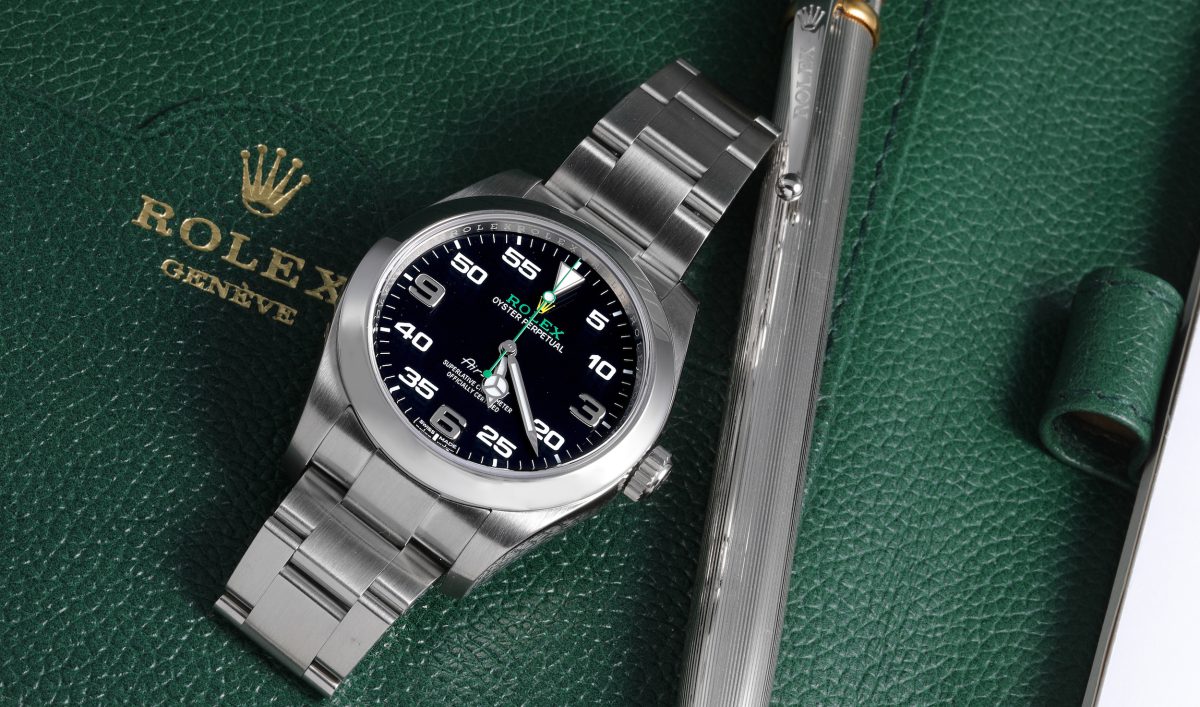
After ref. 114200 was discontinued in 2014, the Air-King completely left the Rolex portfolio and many wondered if that signalled the end of one of the longest-running models. As it turns out, it was just put back in the oven as a very different package emerged two years later in 2016. A lot of enthusiasts (including myself) believed that the soul of the Air-King began to fade with this newest ref. 116900, a watch that was a world away from the traditional ethos. A different animal entirely. We now had a 40mm case (a massive leap from 34mm), a broader bezel and white gold Mercedes hands almost jarringly replaced the more conservative baton counterparts. In fact, the case was now shared with the Milgauss, along with the movement and antimagnetic inner case. The only thing that made this an “Air-King” was the familiar script on the glossy black lacquered dial, now moved above 6 o’clock as OYSTER PERPETUAL was printed below a green ROLEX under a yellow coronet. Oh, and the lollipop seconds hand was also green with a Chromalight aperture. Again, jarring. The dial only came in black with a mishmash of Arabic numerals – there was the applied 3, 6 and 9 o’clock that we know mixed in with a seconds/minutes timing scale (5 to 55) that was inspired by Rolex’s own dashboard instruments produced for the Bloodhound SSC supersonic car (a British jet and rocket-powered car designed to reach land speeds over 1,000mph). The sound barrier is broken on land at approximately 760mph for reference. The car never achieved its goals and the partnership dissolved.
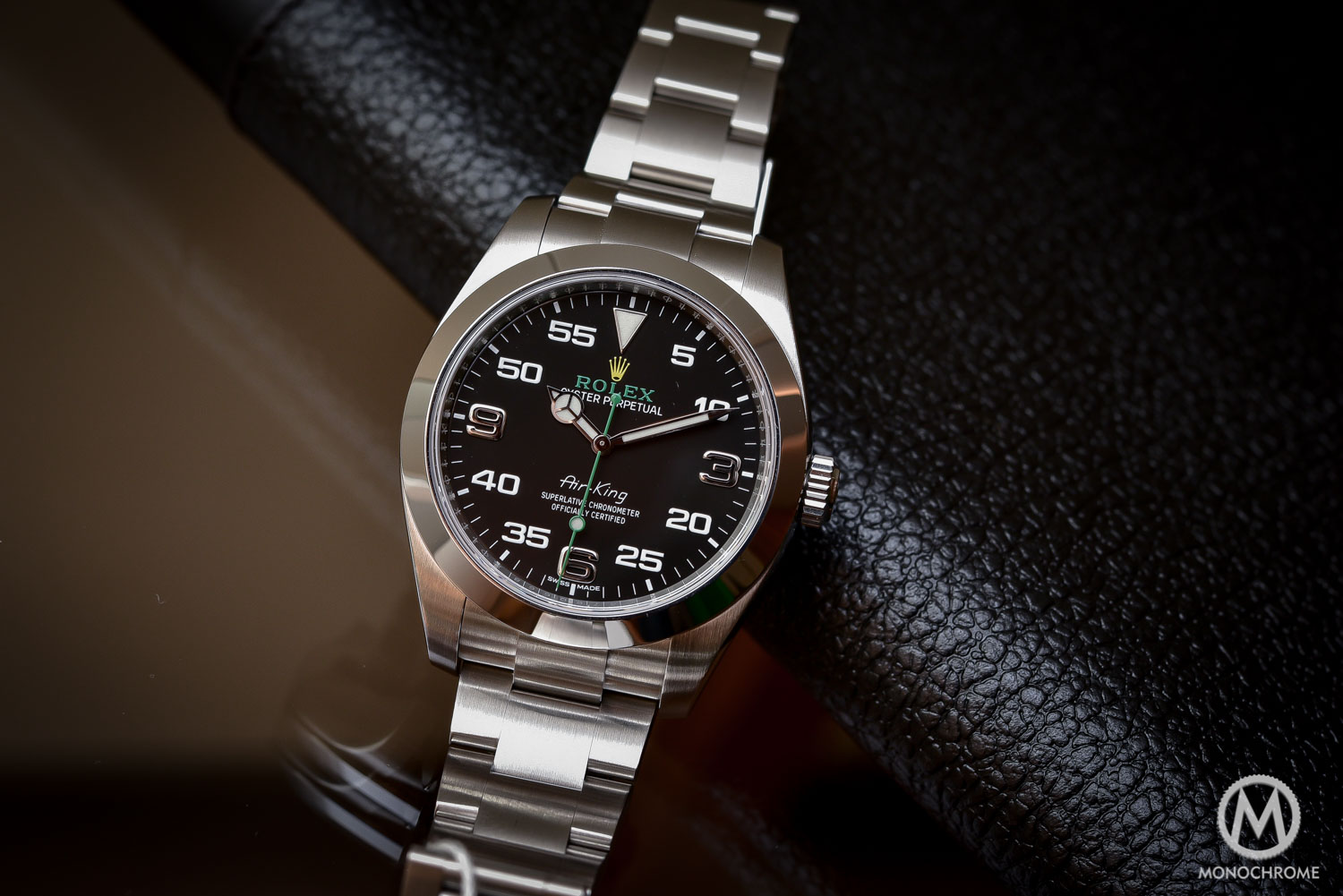
The movement was upgraded to calibre 3131, which is an improved calibre 3130 from before with a 48-hour power reserve and Paramagnetic Parachrom Blue hairspring. It first debuted in 2007 for the Milgauss and these are the only two models to share it.
The Air-King Reference 126900 (2022 – present)
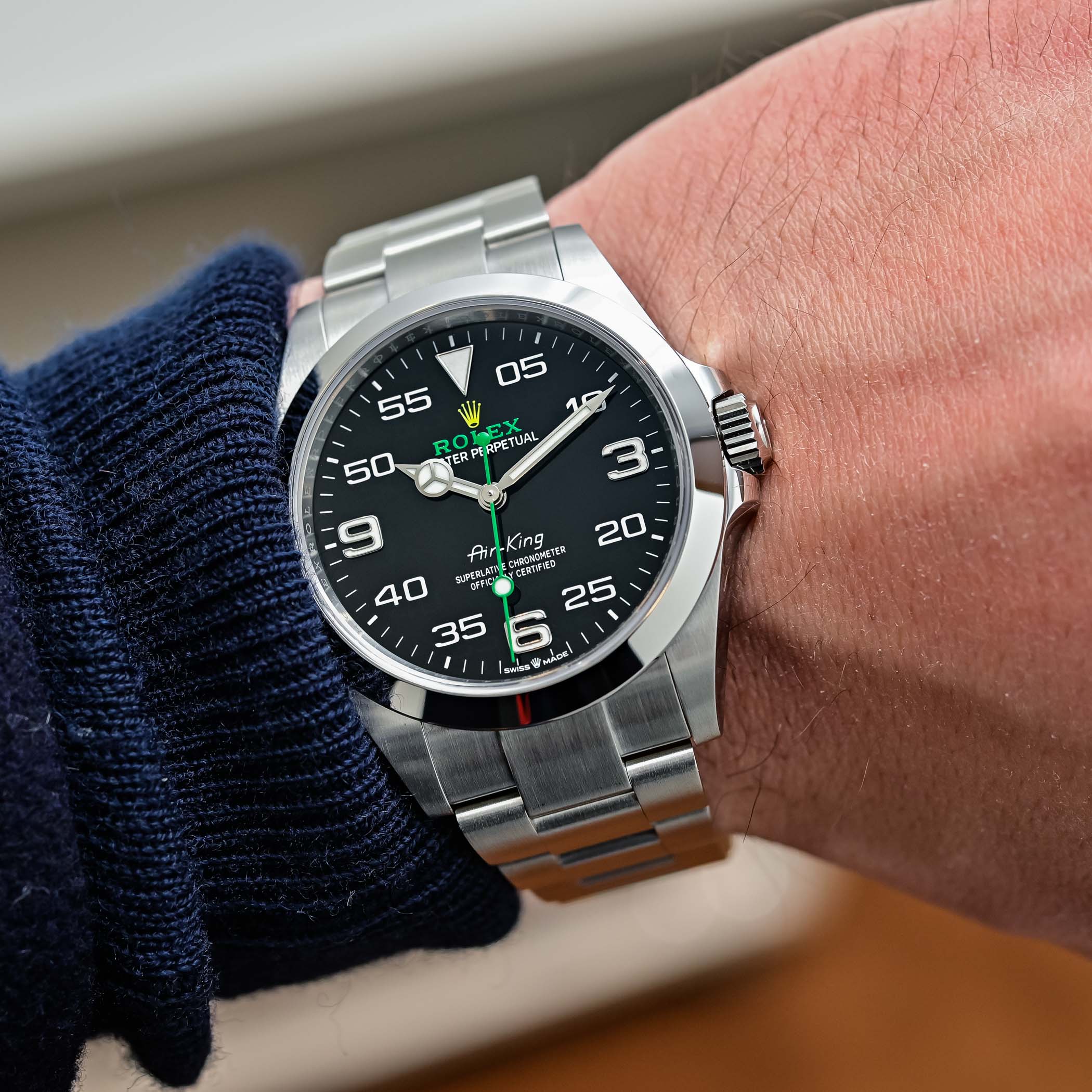
The newest Air-King 126900 looks much like its immediate predecessor, but there are many differences. The 40mm case is now similar to the GMT-Master II (as the Milgauss was discontinued) with lines a bit sharper, wider lugs, a narrower bezel and a full crown guard (a first for an Air-King). However, the antimagnetic inner case remains. Like virtually all modern Rolexes, the new movement – calibre 3230 – has the latest Rolex Chronergy escapement, which lightens/skeletonizes the escapement and modifies the escape wheel teeth and pallet stones, improving efficiency by 15% and bringing accuracy to +/-2 seconds per day. It wasn’t that long ago when Air-Kings were simply PRECISION models without even COSC certification. A huge jump for the traditionally humble series to say the least.
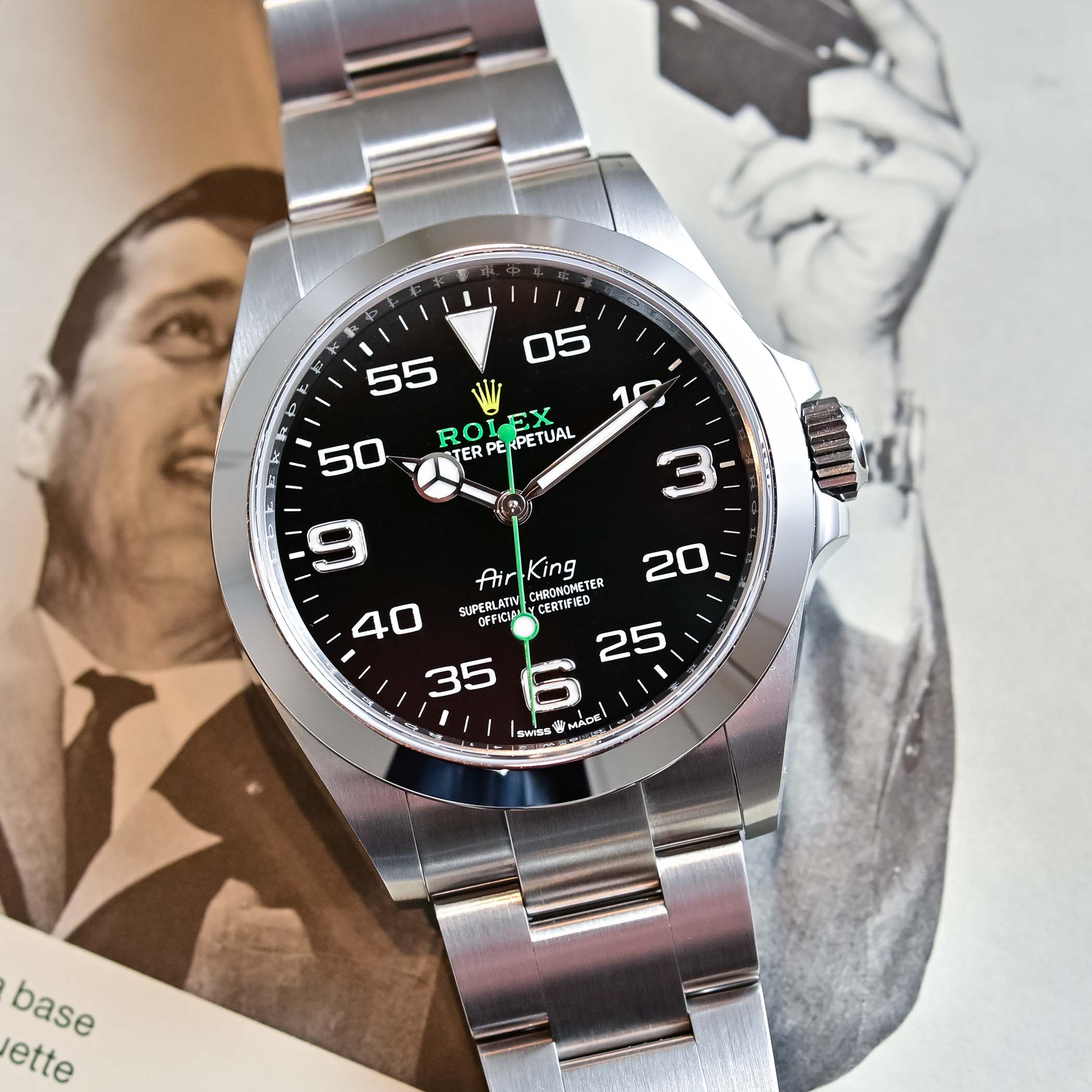
The black dial is very similar to the ref. 116900, but there are a few subtle changes. First, the 5 is now 05 at the top right, while the applied 3, 6 and 9 Arabic numerals have Chromolight inserts like the Explorer (they were solid on ref. 116900). The bottom index below the 6 has also been removed, making room for a printed coronet between SWISS and MADE.
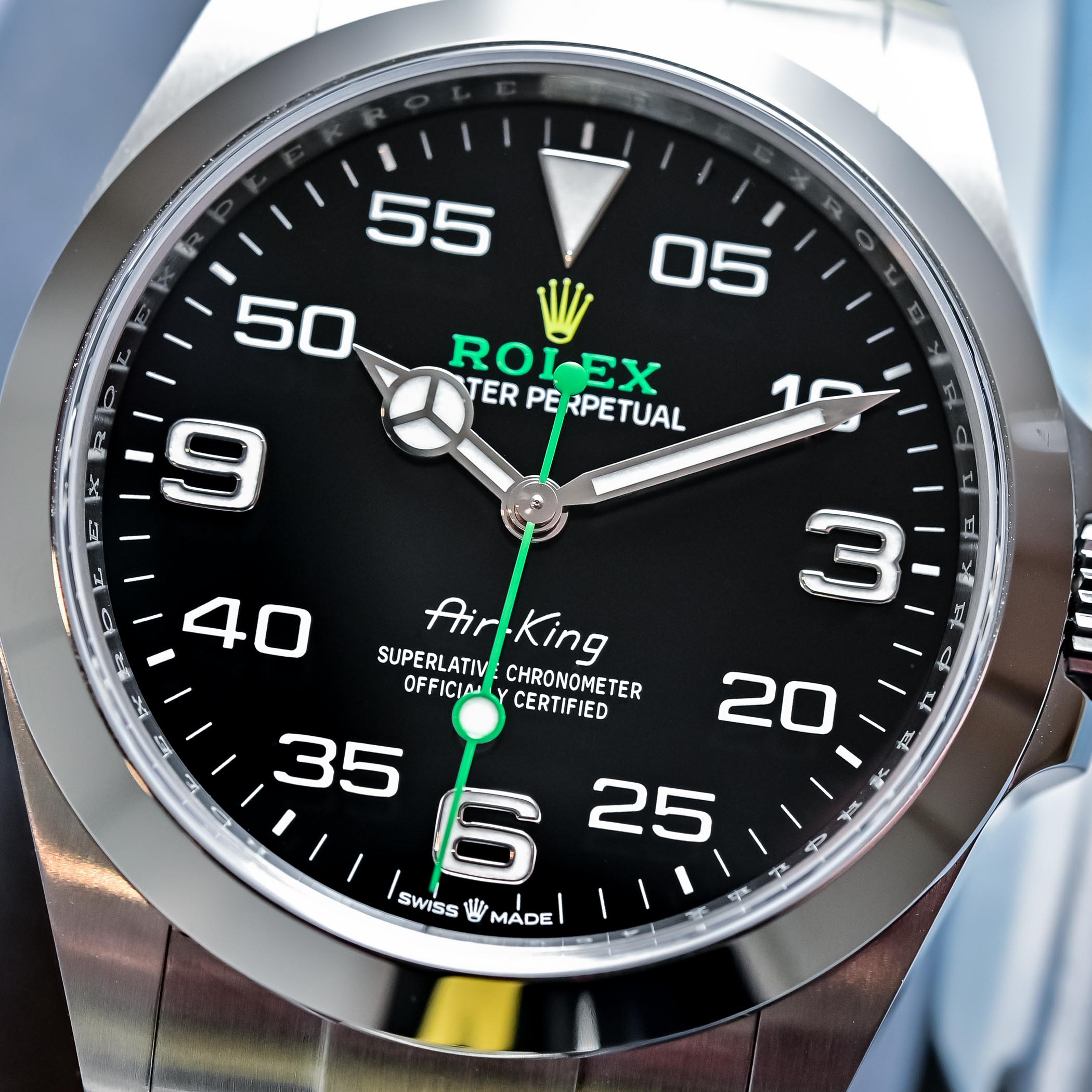
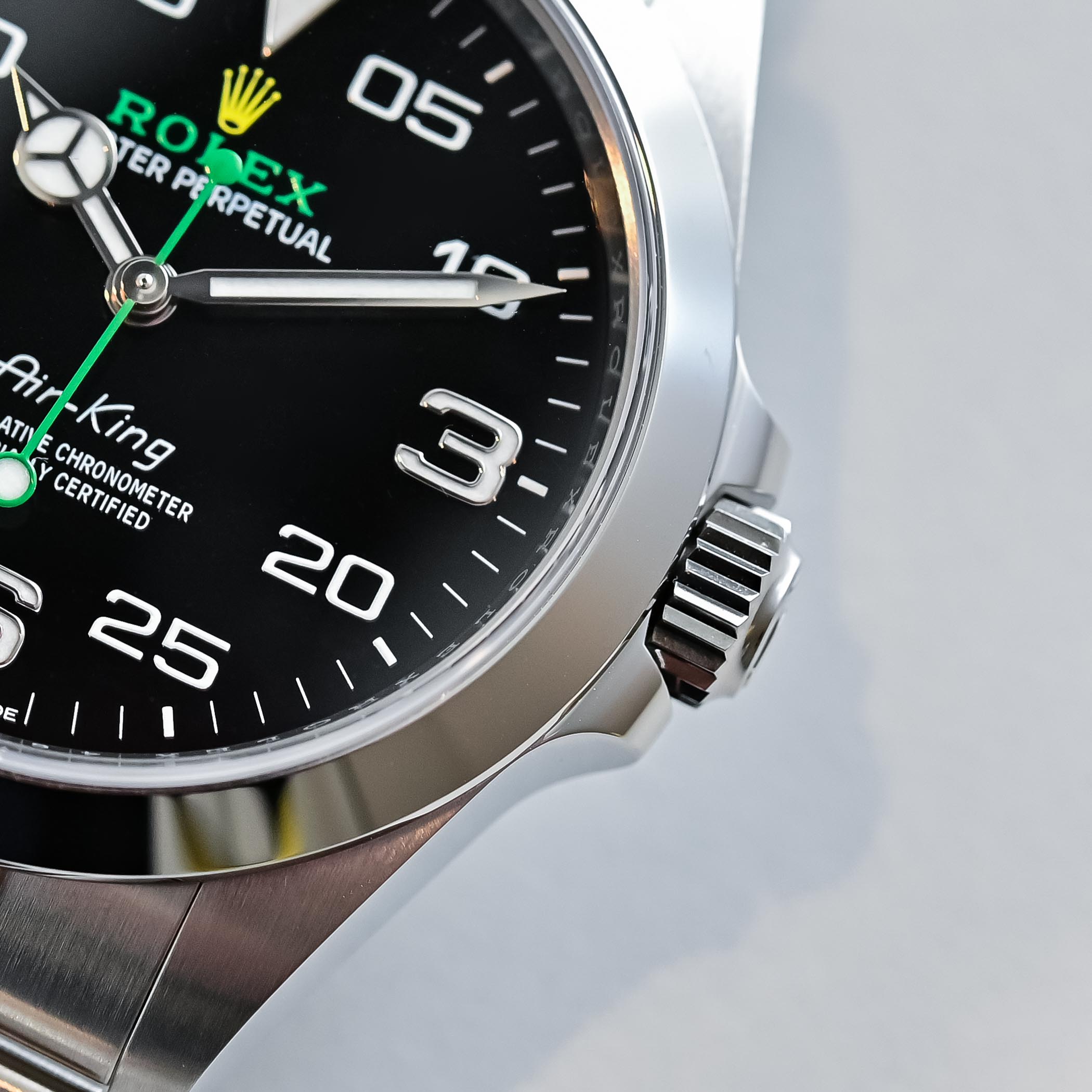
It’s a bit strange how much the Air-King has evolved, given how restrained Rolex is with its core portfolio. Look at the Explorer, Explorer II, Submariner, GMT Master II, Day-Date, Datejust and so on and you’ll see a consistent design language throughout they’re entire production lives, even with inevitable upgrades. The Air-King maintained that for much of its life, particularly through the 5500, 5700 and 14000 eras, but it’s now a completely different high-end sports watch. That’s certainly not a bad thing, but it does remove some of what made the Air-King unique and special. We already have the Explorer and Datejust, for example, and it almost seems like the Oyster Perpetual has stepped into the Air-King’s role after a promotion. Perhaps I’m too much of a purist, but I don’t see much of an Air-King with the latest generation. A very cool and mature Rolex sports model, yes, but an Air-King?
Collectors and Enthusiasts
One of the great things about the Air-King is affordability for collectors and enthusiasts. A very long production run, especially with ref. 5500 and 14000, coupled with this being an affordable model by design (until very recently) make preowned Air-Kings fairly easy to buy. You can find a nice, well-running ref. 5500 model for less than USD 2,500 (minus the Oyster bracelet) and USD 3,000 will get you a complete, original piece. That’s an exceptional value for a solid, preowned Rolex these days. A nice ref. 14000 goes up about USD 1,000 for a total of USD 4,000 for a piece with an Oyster bracelet, while a ref. 5700 Date model can be had for less than USD 3,500 if you like the Oyster Perpetual Date vibe. If you’re an enthusiast who just wants a nice Rolex experience that won’t break the bank, any of the above will more than fit the bill. In fact, a light polish and service will give you a Rolex that many onlookers will think is new.
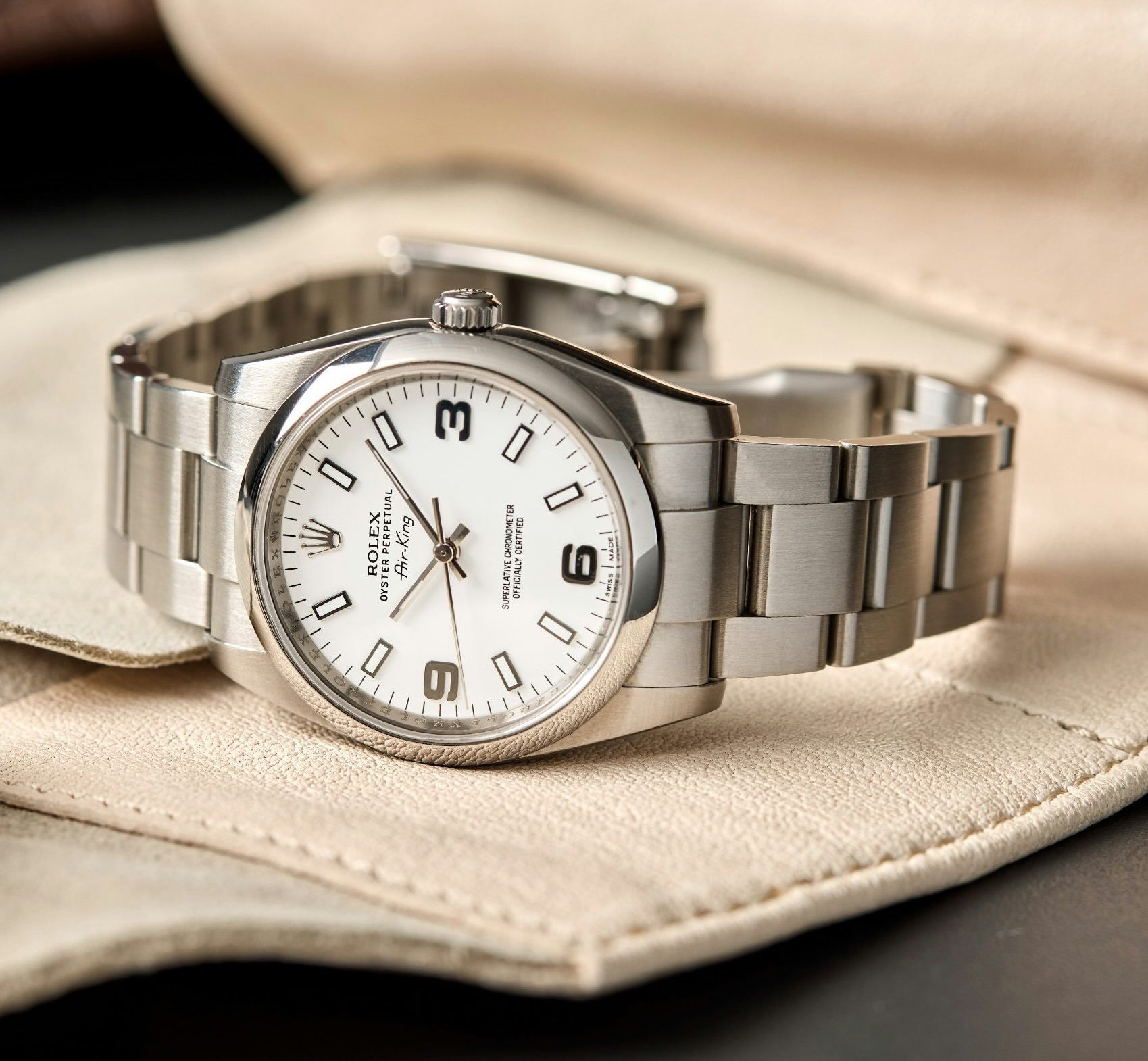
If you prefer something more contemporary, ref. 114200 can be had for less than USD 5,000, while the recent 116900 can be found for less than USD 6,500 and the newest 126900 can be found for around USD 7,500. Keep in mind, the latter two models are now high-end, COSC-certified Rolex sports watches with contemporary 40mm cases and significant magnetic resistance.
Serious collectors, however, are after very early or special models, although even many of those are surprisingly affordable. An original ref. 4925 in nice condition had a high estimate of USD 7,000 at Sotheby’s last September (the final selling price wasn’t listed). For context, a nice Explorer ref. 1016 from the 1960s will set you back around USD 15,000 and that’s a standard model with early(ish) features that had an almost 30-year production run. Special models, like a Domino’s Pizza 5500 can go north of USD 10,000, while a “double red” 5500 can be even more. If you can find a 5500 Explorer hybrid, you’ll need even deeper pockets. However, just look at an early Paul Newman Daytona and you’ll realize just how affordable these are for rare, vintage Rolexes.
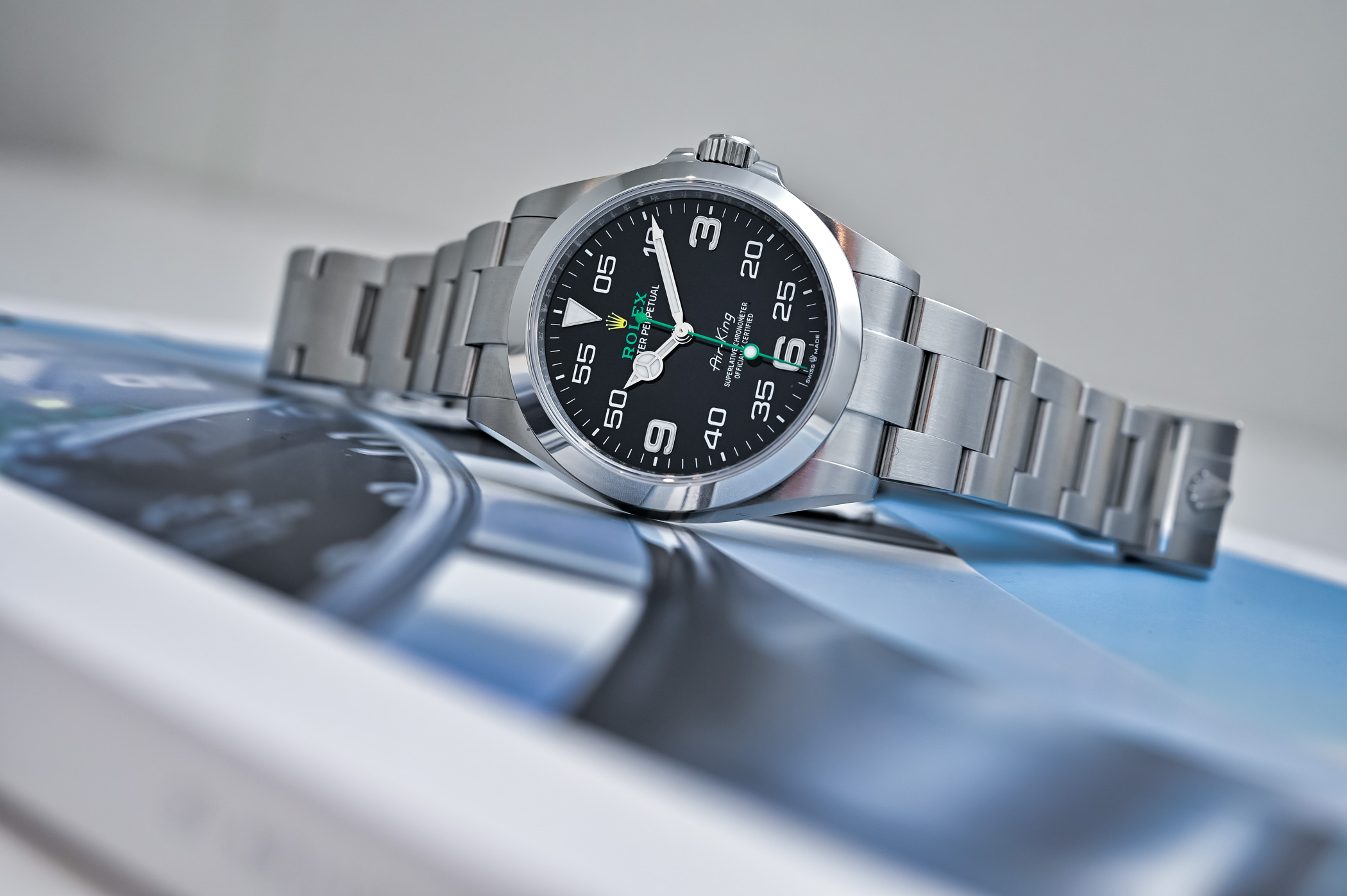
I’m again torn by what the Air-King has become. On one hand, it’s now a thoroughly modern, high-end sports watch that can play on the same field as any contemporary model today. On the other hand, it’s just not the Air-King that I grew up with with an established look going back to the mid-1950s. It kind of reminds me of the recent electric Ford Mustang. Cool and contemporary, but it’s just not a Mustang anymore. But who am I to overly criticize a model that’s now among the brand’s best steel sports watches?
We’ll always have a smorgasbord of traditional preowned Air-Kings on the market with amazing price points, so there’s truly something for everyone. Some may say that the Air-King is the lowly entry-level Rolex, which may have been true in the past (certainly not the case today), but that’s not a bad thing. One of my favourite vintage models is the Oyster Date with a hand-wound movement, on par with early Air-Kings for the “entry-level” tag. As far as I’m concerned, a nice ref. 5500 Air-King provides just as much of a Rolex experience as a ref. 1016 Explorer – and I’m sticking with that statement.
https://www.rolex.com/watches/air-king
Rolex Air King Generations 14000, 14010 and 116900 | SwissWatchExpo
The Rolex Air-King Ultimate Guide

The Rolex Air-King holds a special place in the brand’s lineup, often regarded as an entry point into the world of Rolex watches. While the Air-King may not boast the same level of mainstream recognition as the iconic Submariner or Daytona, it offers a unique blend of understated elegance and exceptional functionality.
The older models of the Air-King exude a timeless appeal with their clean and simple design, making them highly sought after by collectors.

In contrast, the modern version of the Air-King introduced in 2016 breaks away from tradition with its distinct aesthetic. Featuring a larger 40mm case size, bold Arabic numerals on a black dial, and a robust Oyster bracelet, the modern Air-King stands out from the rest of Rolex’s catalog.
Whether one is drawn to the classic charm of the vintage models, or the contemporary allure of the latest iterations, the Rolex Air-King is a timepiece that embodies the brand’s enduring legacy of precision, reliability, and refined style.
Learn more about the history and models within the collection with SwissWatchExpo’s Rolex Air-King Ultimate Guide.
<>
Rolex Air-King: A Brief History
The Rolex Air-King has a fascinating history that spans over seven decades. Introduced in 1945, the Air-King was created to meet the needs of the brave pilots of the British Royal Air Force during World War II. It was a testament to Rolex’s commitment to precision and reliability — qualities that were crucial for aviation.
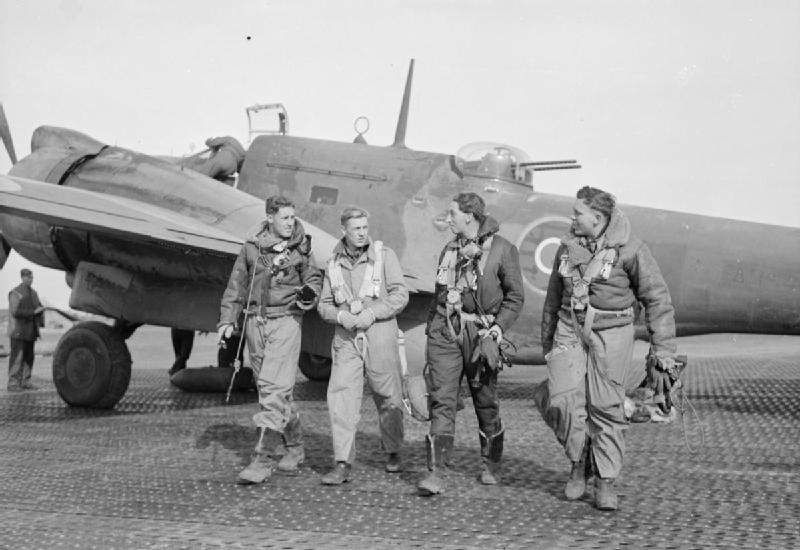
The Air-King was in fact part of four watches created for the British Royal Air Force. The “Air” series consisted of the Air-Lion, Air-Giant, Air-Tiger, and finally the Air-King. While they varied in dial designs, they all came in waterproof Oyster cases and with manual-wind movements.

The early Air-King models featured a clean and understated design, embodying the elegance and simplicity that Rolex is renowned for. These watches were equipped with self-winding movements, allowing for accurate timekeeping without the need for manual winding.
As time went on, the Air-King underwent subtle changes to its design and functionality. From its association with the aviation world, the Air-King, with its minimalist design, time-only function, and robust build, became an entry-level watch of sorts for the brand.

The biggest transformation of the Air-King took place in 2016, when a brand-new design was unveiled. Unlike the monochromatic and minimalist designs of the previous Air-King models, the new ref 116900 was upsized to 40mm (the standard size for Rolex sport watches), and a bold dial that resembles cockpit instruments. The Air-King was later on updated with a new movement and some subtle design changes, but the bold look remained, setting it apart from the rest of Rolex’s catalog.
Throughout its history, the Air-King has remained true to its aeronautical heritag while adapting to the changing times. It has showcased various case sizes, dial options, and materials, ensuring that it remains relevant and appealing to a wide range of watch enthusiasts.
<>
Generations of the Rolex Air-King
First Generation / Four-digit references (1945-1956)
References: 4925, 4365 and 4499
Features: bubbleback cases, manual-wind hunter movements
The inaugural generation of the Rolex Air-King, produced from 1945 to 1957, featured a timeless and understated design. These early models had four-digit reference numbers and a modest 34mm case size. They were equipped with manual movements, providing reliable timekeeping. The dials were typically clean and elegant, often adorned with simple hour markers and the introduction of stick hour markers on a cream dial. These Air-King watches exuded a classic charm that remains highly sought after by collectors today.
<>
<>
Second Generation / Quintessential Air-King (1957-1989)
References: 5500, 5700
Features: 34mm Oyster case, Caliber 1520 and 1535
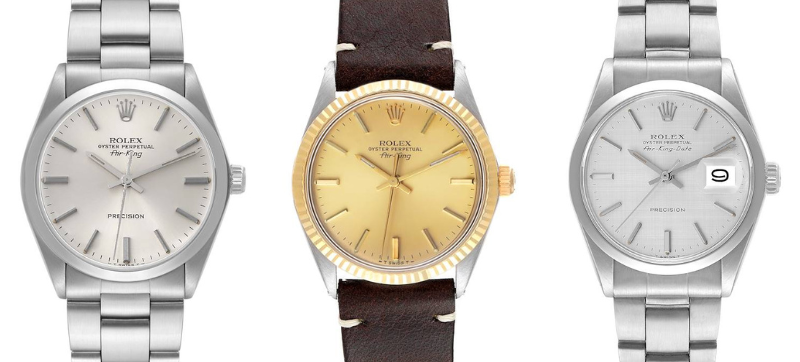
From 1958 to 1989, the second generation of the Air-King watches emerged, solidifying the model’s quintessential status. During this era, the case size maintains the 34mm diameter, offering a slightly smaller presence on the wrist compared to other watches of the era. The Air-King models of this generation embraced a sportier style, with a wider range of dial options. These dials showcased different color combinations, including black, silver, blue, and cream. Some featured unique hour marker designs, such as the iconic “Rolex Air-King” script or the applied coronet logo. These watches represented the perfect blend of elegance and versatility.

Five-digit models, but not yet COSC certified (1989-2006)
References: 14000, 14010, 14000M, 14010M
Features: 34mm Oyster case, scratch-resistant sapphire crystal, 3-6-9 hour markers, Caliber 3000 and Caliber 3130 (not yet chronometer-rated)
Between 1989 and 2006, the Air-King models transitioned into Arabic numerals at 3-6-9. While not yet COSC certified during this period, they still maintained the classic 34mm case size. Rolex introduced several enhancements to these watches, including improvements in materials, dials, and movements. The dials became more varied, offering choices like white, salmon, blue, or black with contrasting hour markers. The ref 14010 featured engine-turned bezels for added visual interest. These Air-King watches retained the elegant and reliable characteristics that made the line so beloved.

Six-digit models, COSC certified (2007-2014)
References: 114200
Features: thicker lugs and solid bracelet links, chronometer-rated Caliber 3130
The Air-King entered the modern era with the introduction of six-digit reference numbers and COSC-certified movements from 2007 to 2014. These watches continued to feature a 34mm case size, but Rolex incorporated updated materials and technology to enhance durability and accuracy. The bracelets received attention as well, with options like the iconic Oyster bracelet or the sporty Oysterclasp. The dials showcased a range of colors and designs, from classic silver to more contemporary blue or black. These Air-King models combined the timeless appeal of the past with modern advancements like a white gold fluted bezel.
Modern era 40mm cases (2016-present)
References: 116900, 126900
Features: 40mm Oyster case, bold black dial with two-digit hour indices, vintage Rolex Air-King logo, Caliber 3131 and Caliber 3230
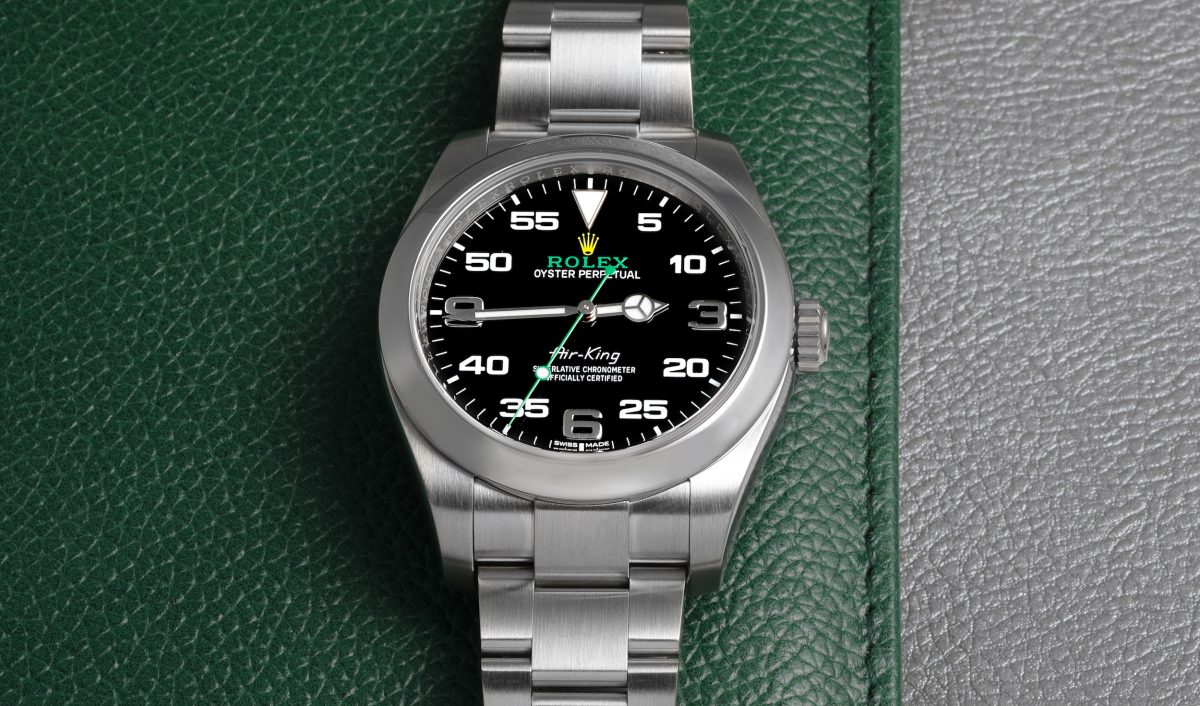
In 2016, Rolex unveiled the latest incarnation (ref 116900) of the Air-King, featuring a larger 40mm case size that made a bold statement on the wrist. This modern version broke away from the traditional design and adopted a unique aesthetic that set it apart from other Rolex models. The most notable feature was the black dial with large Arabic numerals at 3, 6, and 9 o’clock, and striking green and yellow accents, reminiscent of vintage pilot watches. With an updated Oyster bracelet and the high-performance Caliber 3131 movement, this Air-King captivated watch enthusiasts with its contemporary and distinctive style. Also used in the Milgauss, this movement gives the watch some anti-magnetic properties.
In 2022, Rolex released a slightly revamped version (ref 126900) with more modern bells and whistles. It retains the 40mm case size and bold dial design of the previous edition, but it now comes with crown guards, hour markers coated with Chromalight, an added “0” at the five-minute mark, wider links on the Oyster bracelet, and an improved Oysterlock safety clasp.
<>
Evolution of the Rolex Air-King
Rolex Air-King Materials
Throughout its evolution, the Air-King has incorporated various materials to meet the demands of different eras. Initially, stainless steel was the primary choice, offering durability and a classic look.
During the three-decade long run of the ref 5500, Rolex introduced variations like yellow gold, white gold, gold capped and Rolesor, a combination of stainless steel and gold, providing a touch of luxury. Some models of the ref 114200 were also adorned with 18k white gold fluted bezels.
In the modern era, the Air-King utilizes Oystersteel, a highly corrosion-resistant steel alloy exclusive to Rolex. This material ensures the watch remains robust and maintains its pristine appearance even in challenging environments.
<>

Rolex Air-King Sizes
The size of the Air-King has evolved to suit contemporary tastes and trends. Its humble beginnings resulted in a 34mm case which at the time was considered large.
For the first time in 2016, Rolex introduced the Air-King with a larger 40mm case, catering to those seeking a bolder and more modern look. The increased size enhances the watch’s presence on the wrist, making it more appealing to a wider audience and larger than the new average in the Rolex line of 36mm.
<>
Rolex Air-King Dials and Bezels
The dials of the Rolex Air-King have seen a remarkable evolution throughout its history. In the early generations, the dials maintained a clean and minimalist aesthetic, often featuring simple hour markers and eventually the iconic Rolex logo at 12 o’clock. As the Air-King progressed, Rolex introduced a wider variety of dial options to cater to different tastes. When the ref 14000 hit the market, Rolex experimented with the use of different colors such as black, silver, white, and blue.
Some dials showcased elegant textures like sunburst patterns or guilloché finishes, adding depth and visual interest. The hour markers and hands were designed for optimal legibility, often coated with luminescent materials for enhanced visibility in low-light conditions. Whether it’s the timeless elegance of the early models or the contemporary flair of the modern Air-King, the dials of this iconic timepiece reflect Rolex’s commitment to both functionality and style.

The bezels of the Rolex Air-King have also undergone significant changes throughout its evolution. In the early generations, the Air-King typically featured smooth, polished bezels, contributing to its clean and refined look. However, as the model progressed, Rolex introduced bezel variations to offer more options for enthusiasts.
The ref 5500 and 5700 offered options of two-tone designs, which also meant that some bezels were fluted and fashioned in yellow gold. The ref 14000 also presented an engine-turned bezel and an 18k white gold fluted version.
The fluted bezels, in particular, became synonymous with Rolex and are often associated with their iconic watches. While the Air-King typically emphasizes a more understated approach compared to Rolex’s sports models, the bezel options provide subtle design variations that allow individuals to express their personal style.
Since 2016, the bezel of the Rolex Air-King has only been a smooth, stainless steel design, in alignment with the sporty design of the watch.
<>
Rolex Air-King Bracelets
The bracelet options for the Air-King have evolved alongside the changes in design and technology. The classic Oyster bracelet, known for its robustness and comfort, has been a staple choice throughout the watch’s history.
For reference 5500 to 5700, Rolex introduced the Jubilee bracelet as an alternative option for the Air-King, providing a more refined and elegant aesthetic. Succeeding editions of the Air-King have been with stainless steel Oyster bracelets.
Additionally, the modern Air-King also offers the Oysterclasp with the 5mm Easylink extension system. These bracelet choices allow wearers to personalize their Air-King to suit their style and comfort preferences.
<>
Rolex Air-King Movements
The movements powering the Air-King have undergone significant advancements over time. In its early years, the Air-King utilized manually wound movements, providing reliable and accurate timekeeping. As technology progressed, Rolex introduced self-winding movements in later generations, allowing for automatic winding through wrist movements.
The modern era Air-King boasts state-of-the-art movements, such as the Caliber 3131 (for ref 116900) and new generation Caliber 3230 (for ref 126900). The newest movement offers an increased power reserve of 70 hours from 48 hours, a blue Parachrom hairspring that makes it insensitive to magnetic fields, and accuracy of -2/+2 seconds per day.
Rolex’s commitment to innovation ensures that the Air-King remains at the forefront of horological excellence, delivering exceptional timekeeping performance.
<>
Five Interesting Facts About the Rolex Air-King
#1 – The Rolex Air-King has historical aviation heritage
The Air-King has a rich connection to the world of aviation. It was initially created for the pilots of the British Royal Air Force during World War II. The modern Air-King also draws inspiration from cockpit instruments, reflecting its roots in aviation. This historical significance adds a captivating layer to the Air-King’s story, making it a cherished timepiece among aviation enthusiasts.
<>

#2 – It shares core characteristics with the Oyster Perpetual range
The Rolex Air-King has a unique connection to the Oyster Perpetual collection, serving as a spin-off model within this renowned lineup. While the Air-King maintains its distinct design and identity, it shares the core characteristics of the Oyster Perpetual watches, including the iconic Oyster case and Perpetual movement. This association with the Oyster Perpetual collection further solidifies the Air-King’s status as a remarkable timepiece, benefiting from the exceptional craftsmanship, reliability, and precision that Rolex is renowned for.
However, starting in 2016, the Air-King took a bold departure from its traditional design and embraced a distinct identity that deviated from the typical Oyster Perpetual aesthetics.
<>
#3 – It was originally not the only “Air” model
When the Rolex Air-King was first introduced, it was not the only model within the “Air” series of watches. Alongside the Air-King, Rolex also produced the Air-Lion, Air-Tiger, and Air-Giant models. These watches shared similar design elements and were part of Rolex’s strategy to offer a range of timepieces specifically tailored for different markets and customer preferences. However, over time, the Air-King emerged as the most popular and enduring model from the Air series, eventually overshadowing its counterparts. Today, the Air-King stands as the sole survivor of the Air series, representing the timeless appeal and lasting legacy of this remarkable watch.
<>
#4 – The modern Air-King’s new look is inspired by dash clocks
In 2014, Rolex collaborated with Bloodhound SSC, a British supersonic car manufacturer, to set a new world land speed record. Part of this partnership was the development of a chronograph and speedometer for the supersonic car. These bespoke mechanisms sit on the car’s dashboard, and they served as inspiration for the modern Rolex Air-King dial design, which hit the market in 2016.
<>
#5 – The modern models are no longer considered entry-level models
Traditionally considered one of Rolex’s entry-level watches, the Air-King took a surprising turn in 2016. With the release of the new model, Rolex positioned the Air-King as a more elevated and distinct timepiece within its lineup.
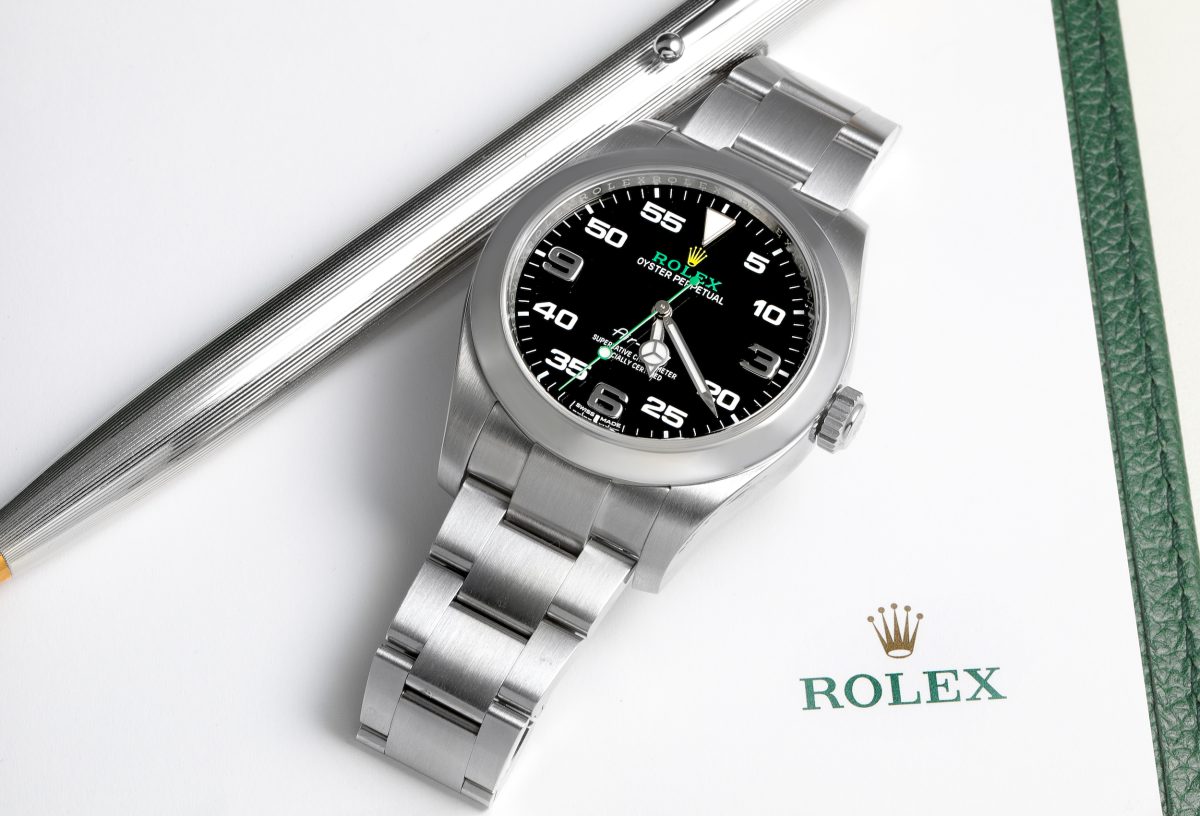
The ref 116900 introduced an innovative design with a black dial featuring large Arabic numerals and a vibrant yellow minute track. This departure from the traditional Air-King design and the shift away from being an entry-level offering marks a significant milestone for this iconic watch.
<>
Rolex Air-King Ultimate Guide – Final Thoughts
The Rolex Air-King is a remarkable timepiece with a captivating history and a legacy that spans over several generations. From its humble beginnings as a tribute to the brave pilots of the British Royal Air Force to its current status as an iconic Rolex model, the Air-King has continuously evolved while staying true to its roots. Whether it’s the timeless elegance of the vintage references or the bold and distinctive design of the modern iterations, the Air-King showcases Rolex’s commitment to precision, reliability, and exceptional craftsmanship.
With their vast selection of pre-owned watches, including an extensive collection of Rolex timepieces, SwissWatchExpo offers the opportunity to find the perfect Air-King that suits your style and budget. Explore our wide selection of Rolex Air-King watches at SwissWatchExpo.com.
A Collector’s Guide to the Rolex Air-King, From 1945 to Present
With prices down, it’s a good time to consider the small, almost dressy Air-Kings of the early years straight through to the modern model.
 Chris Olmhunter, Vintage watches Centre, Swiss Watches
Collecting Rolex watches is, for many, their sole horological pursuit. Few watch companies provide such a satisfyingly complete and ample array of compelling and iconic watches scattered across the planet, from weird little design-forward dress watches like the Rolex King Midas to icons of world-record-setting derring-do like the Explorer, GMT Master, Daytona, and Submariner. But the Air-King is humbler, usually smaller, and far less complicated (mechanically and culturally)—which is exactly why the Air-King is so well suited to the quiet luxury of this post-pandemic moment when even modern Rolex is chilling out and acting like Rolex again.
Rolex launched the Air collection in 1945 as a tribute to the pilots of World War II, and as a prescient offering to the soon-emerging jet-set. The Air collection included the Air-King, Air-Giant, Air-Lion and Air-Tiger, but only the Air-King survived this initial launch. Excluding a short interruption in 2014, the Air-King has been continuously produced since 1945, such that there is a seemingly endless supply of vintage, neo-vintage and pre-owned Air-Kings available at any time. It can be a lot to sort through.
Like many Rolex models of the mid-20th century, the Air-King was part sports watch and part dress watch. The sports watch characteristics originally included the waterproof stainless steel Oyster case and robust shock resistance, both of which were improved incrementally over the decades. In 1953, the Air-King got an automatic winding movement and at the surprisingly late date of 2007 it acquired chronometer-grade precision. The dress watch characteristics originally included a relatively small, lugged case, a plain stainless-steel bezel, a simple dial, and time-only functionality. Compared to the venerable Datejust (1945) and Day-Date, the Air-King was a modest proposal.

Rolex has always been an industrial watchmaker, meaning that the company makes as few interchangeable parts as possible and builds multiple products from them. The Air-King, therefore, was a close cousin to the Oyster Perpetual and Milgauss (at times identical other than dial designations), as well as the Rolex Explorer I (which was originally just 2 mm larger than the Air-King and later the same size). These similarities have remained relatively stable throughout the years, as Rolex hasn’t altered its modular production schemes.
When collecting any Rolex model, it is always helpful to understand what differentiates four-digit, five-digit and six-digit reference numbers. If you’re not familiar with the “digits,” here is the basic scheme (though not every model conforms to these dates exactly).
- Four-digit serial numbers: ~1945 to 1978
- Five-digit: 1979 to 2000
- Six-digit: 2000 to present
Most of the significant changes from the different digit eras have affected watches more complicated than the Air-King, like the Datejust, as well as dive watches, like the Submariner and Sea-Dweller. The Air-King did, however, see changes in case-size and in the movement over the years, and of course the dials varied quite a lot. Though the Air-King changed less than other models, the digit designations still delineate meaningful eras among collectors, especially the jump from five- to six-digit with the Air-King.

This guide aims to be as exhaustive as possible, but we humbly submit that there is always something new to learn. The Air-King’s history is rife with rumors, misinformation, and weird exceptions to most of the rules one might try to establish. This is largely true of any Rolex model, and the confusion is largely the result of Rolex being an industrial juggernaut that used interchangeable parts willy-nilly without keeping records. Where there’s a rule about a Rolex, there’s an exception.
The confusion is especially rife during “transition years” when Rolex upgraded components, but not until the old supply was depleted, with the result being some odd concoctions with old and new parts together in one watch. Transitional years usually follow a digit change, four to five, and five to six. Another confusing issue is that the Air-King sometimes shared reference numbers with other models that featured different dials. We will do our best to flag these topics when possible.
As always, you can learn more about the basics of collecting vintage watches in our video tutorial, and for guidance buying your first Rolex, please see our guide.
Below is everything we can share about the Air-King to get you started—or, perhaps, just better sorted—on your journey into one of the most iconic Rolex models.
Air-King Reference 4925, Manual-Wind, Center-Seconds (1945-1953)

The 4925 is the one that started it all. It was a simple, stylish, sporty watch that was ready for the burgeoning jet-set lifestyle of the post-war era. The 4925 is a must-have for any Air-King enthusiast. Here are the core features.
- 34mm Stainless Steel Oyster case with 50 meters water resistance, screw-down crown and drilled lugs set 19mm apart
- Leaf hands in gold, blued second hand
- Acrylic crystal
- Caliber 10.5 movement with 15 jewels, frequency of 18,000vph, manually wound, time-only with central seconds
- Dial – white eggshell with gold applied Arabic numerals, italicized printed font reading ‘ROLEX’ under that ‘OYSTER AIR-KING’ and a printed Rolex logo.
Air-King Reference 4499 (1946-1953)

The 4499 is almost identical to the 4925, except it utilizes an upgraded 17 jewel 10.5 caliber and “PRECISION” printed on the dial.
Note: It is possible to find other Rolex Oyster models with this reference number, something we will see happen at various points in the history of the Air-King.
Air-King Reference 4365, Manual-Wind, Sub-Seconds (1945-1953)

This reference can be found as an Air-Lion, Air-Giant and as an Air-King. This differs from the above 4925 for having its seconds on a sub-dial at six o’clock and the word “PRECISION” above that sub-dial.
Other than the movement configuration and variance on the dial printing, the 4365 is identical to the reference 4925 above.
Air-King Reference 6552 (1953-1957)

The 6552 Air-King set the template for the next five decades. The venerable caliber 1030 was more accurate and durable than its predecessors and was used in Explores and no-date Submariners throughout the four-digit era.
- 34mm Stainless Steel Oyster case. 50m water resistance, screw-down crown and drilled lugs with 19mm spacing
- Acrylic crystal
- Automatic caliber 1030 with 25 jewels, frequency of 18,000vph, time-only with central seconds.
- Alpha hands (a kind of long leaf-shape common on Rolexes of the 1950s)
- Dial includes white eggshell paint, script-style Air-King logo and “Super Precision,” both an applied ROLEX and coronet (crown) logo, and either stick markers or 3 , 6 , and 9 in Arabic with supporting arrow markers.
- 3-link Oyster bracelet (a history of which you can find here)
Ryan Gosling has often been seen wearing a reference 6552 like the one pictured above.
The Elusive 6652

We have seen mention of an Air-King 6652 in various articles and forums, but we can’t find anything to confirm these claims. As far as we know the 6652 was never produced as an Air-King. Rolex expert Eric Wind told Robb Report, “I don’t remember seeing a 6652 ever and have never had one, so I don’t have much to contribute. Perhaps it was a myth or urban legend that just kept repeating over the years.”
Air-King Reference 5500 (1957-1989)

The Air-King reference 5500 defies the four-digit limits, extending its run for an impressive 32 years, and overlapping with many other models that had already transitioned into five-digit reference numbers (such as the Submariner and GMT Master). This reference sees a few stylistic tweaks over the 1960s, and collectors will be careful to mind those changes and try to make sure they’re getting an all-original model that wasn’t given service parts (especially hands). However, as we see often with transitional Rolex models, the occasional anomalous example might just be like that from the factory—but remain leery of anyone assuring you of such a claim.
Here are the specifications of the 5500, with as many updates features as we could find.
- 34mm Stainless Steel Oyster case. 100m water resistance, screw-down crown and drilled lugs with 19mm lug spacing
- Acrylic crystal
- Alpha hands from 1950s – into the late ‘60s, and baton hands with pointed ends starting in the late ‘60s.
- Two movements ran concurrently: The 1520 used 26 jewels and operated at a frequency of 19,800vph, offering time-only with a center seconds. It includes flat hairspring and a stick regulator, and was not chronometer-graded. Caliber 1530 used either 25 or 26 jewels, beat at a frequency of 18,000vph, and was also time-only with center seconds, and included a Breguet over-coil hairspring and Microstella regulator, making it suited for the chronometer-grading it received.
- Dials: “PRECISION” indicates the Cal. 1520. “SUPER PRECISION” indicates the Cal. 1530. Applied stick hour indicators and coronet. White, black gilt, salmon, blue, gray, silver (the most common), 3,6,9 dials. Co-branded dials include Tiffany & Co., Domino’s Pizza, Intairdril, Winn-Dixie ‘Safe Driver’ dial, given to truck drivers with a great safety record.
- Bracelets – Oyster 3-link: 7205 – up until 1967, 7835 – 1967 to 1975, 78350 – 1975 to end of run. Please note that transition years can find watches with either bracelet, and that many watches will have replacement bracelets that won’t appear to match the year of production.
36 mm Air-King Reference 5504 (1958-1964)

The 36mm Air-King 5504 was basically an Explorer I with a different dial and hands. Concurrently, Rolex also produced the 5504 36mm Oyster Perpetual. All three are essentially the same watch, with different dials. The Air-King versions are the least common of the three, but by no means uncommon. Here are the specifications of the 5504.
- 36mm Stainless Steel Oyster case. 100m water resistance, screw-down crown and drilled lugs with 20mm lug spacing
- Acrylic crystal
- Alpha hands
- Automatic caliber 1530, 25 jewel frequency 18,000, time-only, center seconds.
- Dial: white egg-shell or black-gilt, both with applied stick markers and “SUPER PRECISION” to indicate the COSC-certified 1530 movement.
- Reference 78360 3-link Oyster bracelet.
Air-King Reference 5501 (1959-1978)

The Air-King gets a bit of Datejust magic in 1960 with the introduction of the reference 5501. Gone is the smooth stainless-steel bezel, upgraded to a fluted gold one that resembles the Datejust. The 5501 shares most other characteristics with the 5500, however. Here are the main characteristics.
- 34 mm Stainless Steel Oyster case, gold fluted bezel. 100m water resistance, screw-down crown and drilled 19mm lugs.
- Acrylic crystal
- Automatic cal. 1520, 26 jewels (Note, US 17 Jewels, because import regulations) frequency 19,800, time only
- Alpha, then moving to baton/pencil hands.
- Dial will read “Swiss” and then moving to “T Swiss T” (along the same timeline as the 5500). Dials were silver, champagne, and sometimes slate. There is a lot of variation with dials on the 5501, as we would expect with such a long run. Most marked ‘OYSTER PERPETUAL AIR-KING’ ‘PRECISION’ (hand-written script AIR-KING) but we will see Tiffany signed, ‘EXPLORER’ marked (with Alpha hands) and even some only ‘OYSTER PERPETUAL AIR-KING’
- Over its 19 years, the 5501 can be seen with two tone oyster bracelets reference 6635 and 7205 and later the two-tone 62523 Jubilee.
40-Micron Gold-Capped Air-Kings

These watches come to us in a number of overlapping references, but are essentially the same watch with differences in the movements. The references of gold-capped Air-Kings are:
- 5506 (1960 – 1964)
- 5516 (1960 – 1965)
- 5502 (1960 – 1965)
- 5520 (1960 – 1970)
Gold-capping is a method in which gold is rolled onto the stainless-steel case to form a thick covering. For Rolex, gold-capped watches are something of an outlier, only appearing on Air-Kings and Oyster Perpetuals during the 1960s.
- 34 mm stainless-steel Oyster case, gold-capped at 40 microns with 100m water resistance, screw-down crown and drilled 19mm lugs
- Acrylic crystal
- Reference 5506, 5516, 5502 use caliber 1530 with 25 jewels, a frequency of 18,000vph. Reference 5520 uses caliber 1520 with 26 jewels and a frequency of 19,800vph. Bot offer time-only with central seconds. As always, caliber 1530 watches are marked “SUPER PRECISION” and caliber 1520 “PRECISION.”
- All use Alpha hands except the reference 5520, which sports baton hands. All hands are and markers are gold.
- Dials are most commonly silver, but you will find champagne and black examples.
- The gold capped Air-Kings used the capped 78351 Oyster bracelet.
Air-King Date Reference 5700 and 5701 (1959-1988)

There was a time when Rolex produced 34 mm models with date complications. Sadly that time has passed, but if these little gems interest you, the 5700 and 5701 are something to look at, and they represent a somewhat uncommon—if not entirely rare—niche of Rolex where good value is still possible.

- 34mm Stainless Steel case (5701 used a gold-fluted bezel and crown) with 100m water resistance, screw-down crown and drilled 19mm lugs.
- Acrylic crystal
- Automatic caliber 1525 (based on 1520) with a frequency 19,800, with time and date, (not quick-set)
- Like the 5500 the 5700 started with Alpha hands and moved over to the baton/pencil hands in the mid sixties.
- Both the 5700 and 5701 came with white, silver, black and champagne dials. Both marked “PRECISION” and they continued with the hand-written script, this time “AIR-KING-DATE” The hands and markers on the 5700 are stainless steel and on the 5701 are gold.
- 6636 Oyster bracelets, replaced in the nineteen seventies with the 78350. The 5701 also came in a 5701/3 model, this time with a smooth bezel.
Air-King Reference 14000 (1989-1999) and 14000M (2000-2006)

We are deep in neo-vintage territory with the 14000. The Air-King is beginning to look like something we would recognize today. In are sapphire crystals, hacking movements and a new hand-set, one in which the pencil tips are gone, as are the drilled lugs. The Air-King now has the same baton hands as the Datejust or Oyster Perpetual, making it both more modern and more like its cousins.
The “M” designation indicates a “modified” version that has an upgraded movement that includes a Parachrom hairspring and COSC chronometer certification. The higher quality movement still gets the dial designation “PRECISION.”
The Air-King gets a little more playful with the dials now in white, black, silver, salmon, blue and with some 3-6-9 versions and even Roman numeralsThe 14000 (M) is found on the 78350 3-link Oyster bracelet.
- 34mm Stainless Steel case 100m water resistance, screw-down crown and non drilled 19mm lugs
- Sapphire crystal
- 14000 Automatic cal. 3000, 27 jewel, frequency 28,800, hacking. 14000M cal. 3130, 31 jewels, frequency 28,800, hacking (M for modified, referring to the upgrade in movement, including the new Parachrom hairspring) both time only
- Early models marked “T Swiss T” used Tritium luminescence, while we see “Swiss Made” with the change to Luminova in 1998.
Air-King Reference 14010 (1991–2001) and 14010M (2000–2006)

These references are essentially the same as the 14000 references above, but with an engine-turned (that is, machine-engraved) steel bezel.
Air-King Reference 114234 (2007 – 2012) and 114200 (2007–2014)

The Air-King only had two models as a 6-digit reference before it took a two-year hiatus between 2014 and 2016. It would be hard to overstate the difference between the earlier Air-Kings and the six-digit references.
All dials are marked “SWISS MADE” and used Rolex’s Chromalight lume. A wide variety of colors were on offer: green, blue, salmon, champagne, white, black and also with roman numerals and exotic dials, including a two-tone version with applied Arabic numerals. There are even some gem-set dials out there (which may be aftermarket, and we can’t confirm that just yet). Hands are the baton type we first saw in the 14000 and are in white gold. The 114234 has an added white gold fluted bezel, giving it an even fancier visage.

- 34mm Stainless Steel case 100m water resistance, screw-down crown and non-drilled 19 mm lugs. The 114234 includes white gold fluted bezel.
- Sapphire crystal
- Automatic caliber 3130 with 31 jewels, a frequency of 28,800vph, hacking, and chronometer certification
Air-King Reference 116900 (2016–2022)

After two years without an Air-King Rolex came back with something so different that one might wonder why it is named Air-King. Gone was an easy-wearing 34 mm everyday watch, and in was a 40 mm sports watch.
It all started in twenty fourteen when Rolex produced two “dashboard dials” for the Bloodhound SSC supersonic car. It was these dash instruments that inspired the Air-King reference 116900, using the same design language and colorway. The 116900 was much more like the Milgauss (they share the same movement, case, antimagnetic inner case). And the new Air-King was less like the Datejust or Oyster Perpetual in purpose and function.
The Air-King now comes with a single matte black dial, still with the hand-script “AIR-KING” and “OYSTER PERPETUAL SUPERLATIVE CHRONOMETER OFFICIALLY CERTIFIED” stacked like a modern Rollie. The controversial dial mixes hour markers with a seconds/minute timing scale, which many people denigrate as “un-Rolex.” The 116900 came with the Rolex Mercedes hands in white gold and a Rolex-green second hand, complete with a sporty luminescent pip.
This Air-King is probably as far from what we had come to know as an Air-King as we could imagine, but it reinvented and revived a model that had been around in basically one form since the 6552 in 1953.
- 40mm Stainless Steel case 100m water resistance, screw-down crown, non drilled 20mm lugs and antimagnetic inner case
- Sapphire crystal • Automatic cal. 3131, 31 jewels, frequency 28,800, hacking, chronometer certified, time only
Air-King Reference 126900 (2022–Present)

The 126900 is the current Air-King model. With this release Rolex leaned more into the tool watch space. The Milgauss-style case was replaced by one more akin to the GMT II (indicating Rolex’s modular production approach, as the Milgauss itself was also cancelled). This new case is a little less rounded and now includes crown guards.
The movement has been upgraded, now with the Chronergy escarpment, giving less wear, hence more reliability. Rolex has rolled out this technology into its various watches over the last few years. One other difference, one you may not even notice at first glance, is that the the “5” on the dial is now an “05.” The 3-6-9 and inverted triangle at 12 are filled with Chromalight, much like the contemporary Explorer I.
- 40mm Stainless Steel case 100m water resistance, screw-down crown, non drilled 20mm lugs and antimagnetic inner case
- Sapphire crystal
- Automatic cal. 3230, 31 jewels, frequency 28,800, hacking, chronometer certified, time only